

The home network environment has never been more demanding, flooded by 8K streaming, high-speed gaming, and hundreds of smart IoT devices. When considering an upgrade in 2025, two primary solutions stand out: the raw power of a single Wi-Fi 7 router or the ubiquitous coverage of a multi-node Mesh System.
Understanding the fundamental trade-offs between a single, hyper-fast Wi-Fi 7 vs Mesh system is crucial for achieving seamless connectivity. This guide dissects their performance, cost, and suitability for different home layouts.
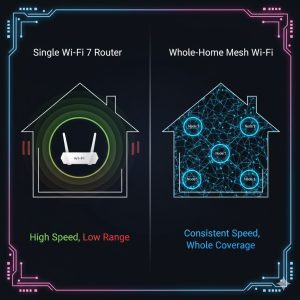
1. Raw Speed vs. Seamless Coverage
The core difference lies in prioritization: speed in one spot versus signal strength everywhere.
- Wi-Fi 7 Router (Single Point): Wi-Fi 7 (802.11be) introduces revolutionary technologies like 320 MHz channels and Multi-Link Operation (MLO), theoretically achieving speeds up to 46 Gbps. A top-tier Wi-Fi 7 router (e.g., TP-Link Archer BE9700) delivers the highest peak speed and lowest latency—ideal for a gaming console or workstation near the router. However, the signal strength drops significantly when traveling through multiple walls or floors.
- Mesh Systems (Multi-Point): Mesh systems (often Wi-Fi 6E or Wi-Fi 7 like eero Pro 7 or Orbi 970) use multiple nodes to blanket large, multi-story homes (up to 10,000 sq. ft. for 3-packs). Their strength is eliminating “dead zones” and providing seamless roaming via a single SSID, ensuring a reliable connection no matter where you are.
2. Cost and Value Proposition
While both technologies have high-end pricing, their value proposition differs based on the size of your home.
| Cost Factor | Single Wi-Fi 7 Router | Mesh System (3-Pack) |
| Initial Cost (2025 Avg.) | $200 – $450 (e.g., TP-Link Archer BE9700) | $550 – $1,000+ (e.g., Netgear Orbi 770/970, eero Pro 7) |
| Best Value For | Small to Medium apartments (under 2,000 sq. ft.) | Large or complex homes (over 3,000 sq. ft., thick walls) |
| Expansion Cost | None (Requires a separate range extender) | Moderate (Adding one node costs $150 – $300) |
For large homes, the Mesh system ultimately offers better long-term value by fixing coverage issues that a single router simply cannot resolve.

3. Ease of Use and Future Proofing
For the average consumer, simplicity and future-readiness are key factors.
- Setup Simplicity: Mesh systems (like those from eero or Google Nest) are famously easy to set up, managed entirely through a single mobile app that guides node placement and configuration. Advanced single routers, while getting simpler, still often require more technical customization for optimal performance.
- Scalability: If you add a garden office or finish a basement, adding a new node to a Mesh system is plug-and-play. Upgrading a single router typically involves complex additions like range extenders, which create separate networks (SSIDs) and reduce seamless roaming.
- The Best of Both Worlds: The latest market offerings are Wi-Fi 7 Mesh systems (e.g., TP-Link Deco BE63). These combine the unprecedented speed of Wi-Fi 7 with the whole-home coverage and ease of use of a Mesh topology, representing the most complete home network upgrade for 2025.
Final Recommendation
| If your primary goal is… | You should choose… | Rationale |
| Maximum Raw Speed (e.g., near the PC) | Single Wi-Fi 7 Router | Superior peak performance and lower latency within a tight radius. |
| Eliminating Dead Zones (e.g., large or multi-story home) | Mesh System (Wi-Fi 6E/7) | Provides reliable signal consistency and seamless roaming across large areas. |
| The Ultimate Upgrade (Speed + Coverage) | Wi-Fi 7 Mesh System | Combines the MLO speed gains with whole-home coverage and easy setup. |

REALUSESCORE.COM Analysis Score: Wi-Fi 7 vs Mesh
To help you make an informed decision, the REALUSESCORE.COM team has analyzed the two major home networking options based on key user experience criteria. The scores are out of 10.0.
| Evaluation Criteria | Single Wi-Fi 7 Router | Mesh System (Average 3-Pack) |
| Maximum Throughput (Raw Speed) | 9.8 | 8.5 |
| Whole-Home Coverage & Stability | 6.5 | 9.7 |
| Ease of Setup & Management | 7.9 | 9.2 |
| Value for Money (for Avg. US Home) | 8.3 | 8.8 |
| REALUSESCORE.COM Total Analysis Score | 8.1 | 9.1 |