
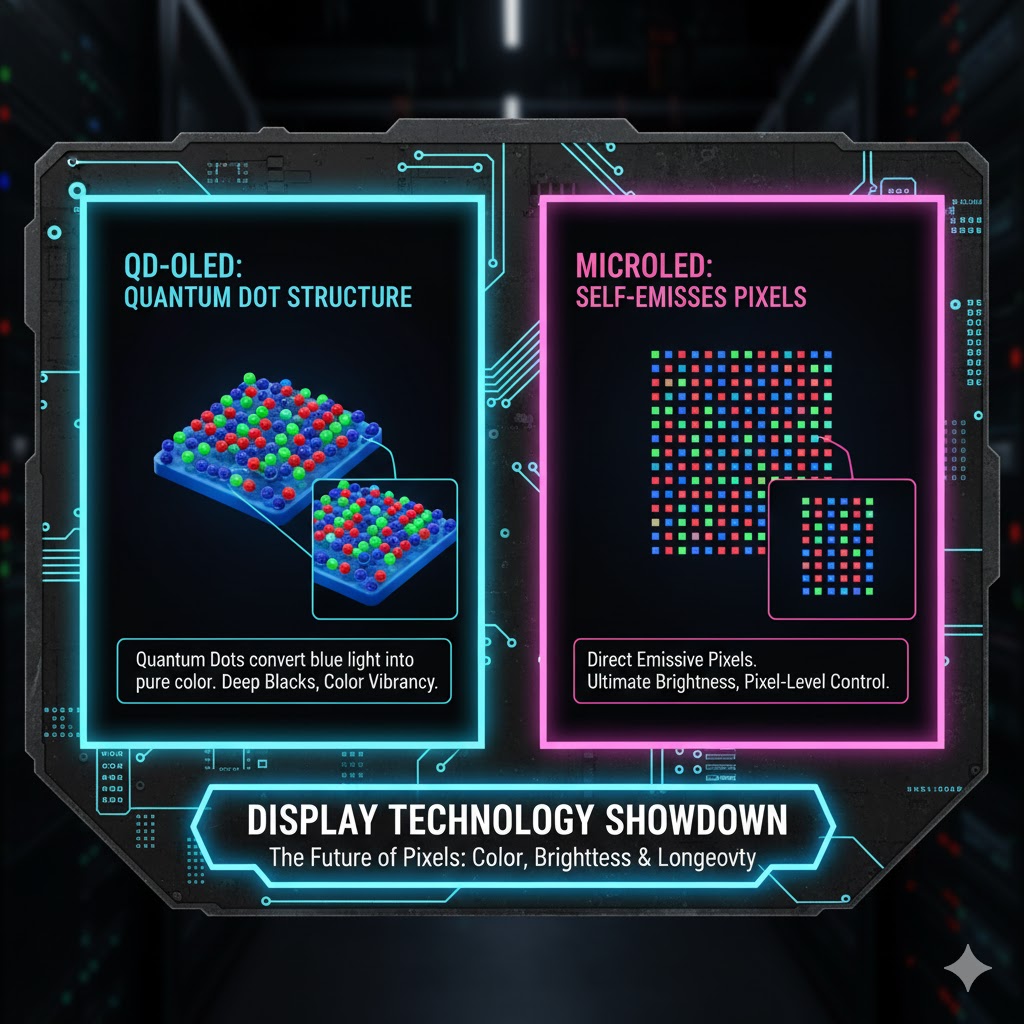
💡 The Infinite Contrast vs The Infinite Brightness The Display War of 2026
The battle for the ultimate home theater display in 2026 is fought between two self emissive display titans: QD OLED Quantum Dot Organic Light Emitting Diode, championed by Sony and Samsung, and MicroLED, the revolutionary inorganic technology still largely confined to the ultra luxury segment. Both technologies promise perfect blacks and unprecedented contrast, but they achieve these goals through radically different means, leading to distinct advantages and disadvantages in real world home theater environments.
For consumers, the choice is no longer just between OLED and LCD. It is a strategic investment into the future of picture quality. This pillar guide provides a deep technical comparison, analyzing critical metrics like sustained brightness, pixel pitch, longevity, and the challenging path to commercialization to determine which technology truly represents the future of large format visual fidelity.
1. QD OLED Technology The Evolution of Perfect Blacks
Sony Bravia and Samsung Display’s QD OLED technology represents the current peak of consumer display technology, building on the strengths of traditional OLED while addressing its color volume weakness.
Core Architecture and Color Volume
QD OLED panels use blue light emitting OLED layers to excite a layer of Quantum Dots (QDs), which then converts the blue light into pure green and red subpixels.
-
Perfect Black Levels: Like all OLEDs, QD OLED achieves absolute black by turning off individual pixels, resulting in an infinite contrast ratio the gold standard for cinematic viewing.
-
Superior Color Volume: The use of Quantum Dots ensures higher color purity and saturation, particularly at high brightness levels. In 2026, QD OLED panels boast a clear advantage in color volume compared to traditional white OLEDs.
-
Response Time: Near instantaneous one millisecond response times eliminate motion blur, making it ideal for high refresh rate 4K gaming and sports.
The Remaining Challenge Burn In and Brightness
While significantly improved through advanced pixel shift algorithms and dedicated cooling layers, the core issue of burn in static image retention remains a concern for prolonged use scenarios like news tickers or persistent gaming HUDs. Furthermore, while QD OLED is brighter than older generation OLEDs, its organic nature limits its sustained peak brightness compared to MicroLED, impacting High Dynamic Range HDR performance in brightly lit rooms.

2. MicroLED Technology The Inorganic Future
MicroLED is the ultimate display technology from a technical perspective. It is the only technology that combines the emissive qualities of OLED with the inorganic longevity and immense brightness of traditional LED.
Core Architecture and Scalability
MicroLED uses arrays of microscopic, self emissive, inorganic LEDs to form individual subpixels. There is no organic material and no need for a backlight.
-
Infinite Lifespan and Brightness: Because the pixels are inorganic, they are immune to burn in and degradation associated with organic materials. They can achieve incredible peak brightness levels, easily surpassing 5000 Nits, making HDR content pop even in direct sunlight.
-
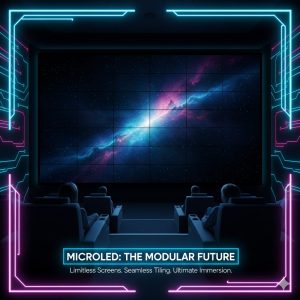
True Modularity: MicroLED displays are built by seamlessly stitching together small, borderless modules. This allows for virtually any screen size and aspect ratio, making it the perfect customizable solution for bespoke home theaters.
-
Pixel Pitch Challenge: The largest barrier to consumer adoption is Pixel Pitch the space between pixels. To achieve a consumer friendly 4K resolution at a standard 65 inch size, the microscopic LEDs must be placed with near impossible precision, making the current cost astronomically high.
3. Technical Deep Dive Brightness, HDR, and Color
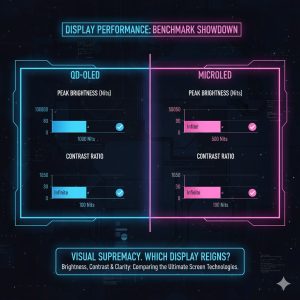
The difference between QD OLED and MicroLED is best analyzed through their performance metrics.
A. High Dynamic Range HDR Performance
| Metric | Sony Bravia QD OLED (2026) | MicroLED (2026 Pilot) | Winner for HDR |
| Peak Brightness | 1500 Nits to 2000 Nits | 4000 Nits to 5000 plus Nits | MicroLED |
| Black Level | 0 Nits (Perfect Black) | 0 Nits (Perfect Black) | Tie |
| Sustained Brightness | Excellent (better than W OLED) | Unrivaled (no ABL Automatic Brightness Limiter) | MicroLED |
While QD OLED offers incredible contrast due to its perfect blacks, MicroLED’s vastly superior brightness allows it to render HDR highlights with a punch and realism that no organic display can match, especially in cinematic scenes designed for high Nits.
B. Color Purity and Volume
QD OLED leverages Quantum Dots to achieve incredible color volume at mid to high brightness levels, a key technical feature. MicroLED, however, due to its pure, single color light emission, offers greater potential for absolute color saturation, though the uniformity of that color across massive tiled screens remains an engineering challenge.
For high-end home theater setups, the entire audio visual chain must be optimized for performance. This includes source components, processors, and even the cooling solution to prevent performance degradation. The investment required for this level of setup is often substantial, requiring careful budgeting. For other high performance hardware investments, review our guide to budget gaming hardware to understand cost effective component selection.
4. Market Readiness and Adoption 2026 Roadmap
The timeline for mass market adoption is the greatest differentiator between these two technologies.
QD OLED Dominance in the Premium Segment
By 2026, QD OLED has firmly established itself as the premium consumer choice for TVs between 55 inches and 85 inches. Its manufacturing processes are mature, costs are falling rapidly, and it offers the best balance of cinematic quality and affordability. The primary market adoption challenge for QD OLED is mitigating consumer fear of burn in.
MicroLED The Ultra Luxury Niche
MicroLED remains a niche technology in 2026, primarily available in very large (90 inches and up) consumer models or bespoke, commercial installations.
-
The Mass Transfer Problem: The process of accurately placing millions of microscopic LEDs onto a substrate Mass Transfer is the bottleneck. Until this process is perfected and yields are high, the cost remains prohibitive—often exceeding 100000 USD for a consumer sized set.
-
Modular Seams: While seamless assembly is possible, the tiny seams between MicroLED modules can sometimes become visible on closer inspection, posing a challenge for critical viewers.
5. Final Verdict Choosing the Future Display
The Sony Bravia QD OLED vs MicroLED debate is a question of present value versus future potential.
| User Profile | Winner | Key Reasoning |
| The Cinephile / HDR Enthusiast | Sony Bravia QD OLED | Perfect blacks, exceptional color volume, and mature, affordable technology. The best contrast for dedicated dark room viewing. |
| The Bright Room / Commercial User | MicroLED | Unmatched peak brightness (5000 plus Nits) eliminates glare. Immune to burn in, making it ideal for multi use or brightly lit spaces. |
| The Scalability Architect | MicroLED | True modular design allows for custom, extremely large home cinema walls limited only by budget. |
For the vast majority of premium home theater consumers in 2026, QD OLED offers the best and most proven blend of contrast, color, and affordability. MicroLED remains the ultimate technological achievement, but its mass market arrival for consumer sized screens is likely still several years away.