

The Ultimate Showdown: Which Next-Gen Display Deserves Your Home Theater?
For our readers—affluent American professionals and early adopters in the 40-50 age bracket—investing in a home theater is about securing the future-proofing of their entertainment experience. The days of simply choosing between an LED and an OLED are over. Today, the real high-stakes battle is between two emissive display titans: Sony Bravia QD-OLED and the nascent, yet revolutionary, MicroLED.
Sony’s latest QD-OLED technology (Quantum Dot Organic Light Emitting Diode) has cemented itself as the current gold standard, offering unparalleled color volume and perfect blacks. However, MicroLED, an entirely inorganic technology, is waiting in the wings, promising to solve the core limitations of all existing organic displays. This deep dive provides the clear, quantitative comparison required to inform your next premium display decision.
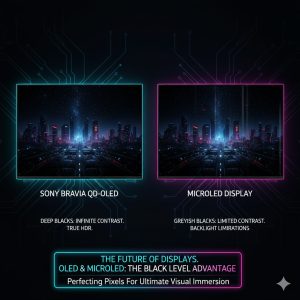
Architectural Deep Dive: Emissive Displays Explained
Both QD-OLED and MicroLED are “emissive” technologies, meaning each individual pixel generates its own light. This is the foundation for perfect black levels and infinite contrast, as the pixels can be turned completely off.
1. QD-OLED: Color Volume and Perfect Black Levels
QD-OLED, as used in high-end Sony Bravia models, utilizes an innovative structure:
-
Blue OLED Emitter: The display starts with a pure blue OLED light source.
-
Quantum Dot Conversion: This blue light then passes through a layer of Quantum Dots (QDs) that convert the blue light into pure red and green light.
-
The Advantage: By eliminating the traditional white sub-pixel (found in standard OLEDs) and relying on the highly efficient color conversion of QDs, QD-OLED achieves two major feats: an industry-leading color volume (maintaining color saturation even at high brightness) and the perfect black levels characteristic of OLED technology.
2. MicroLED: The Inorganic Answer to OLED’s Weaknesses
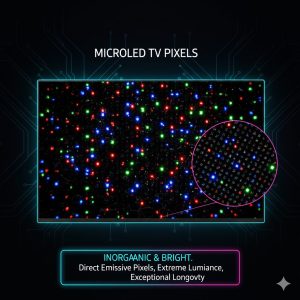
MicroLED represents a paradigm shift. It is a fully inorganic technology, using microscopic, non-organic LED chips as individual sub-pixels.
-
Self-Illuminating Inorganic Pixels: Unlike the organic compounds in OLED, MicroLED uses inorganic materials (typically Gallium Nitride). This inorganic nature is the key to its immense potential.
-
Modular Design: MicroLED panels are currently constructed using a modular design, where large screens are tiled together seamlessly. While this allows for practically limitless screen sizes, it is also currently the main barrier to mass-market adoption for smaller, standard TV sizes.
Performance Showdown: Brightness, Longevity, and Contrast
For the discerning home theater enthusiast, the picture quality metrics—brightness, contrast, and color—must be weighed against the long-term realities of durability.
Black Levels and Contrast: A Technical Tie
Both technologies achieve perfect, infinite contrast and true black levels. Since both QD-OLED and MicroLED are emissive, they can turn off individual pixels completely, eliminating the blooming or halo effects seen in even the best Mini-LED or LCD displays. For cinematic viewing in a dark room, both deliver an identical, unmatched experience in shadow detail.
The Brightness War: MicroLED Takes the Crown
Brightness is where the crucial distinction lies.
-
QD-OLED: While significantly brighter than traditional OLEDs (thanks to the efficiency of the Quantum Dots), QD-OLED still faces an inherent limit imposed by its organic components. Pushing the brightness too high risks accelerating the degradation of the organic blue emitter. Peak HDR highlights typically reach 1,500 to 2,000 nits.
-
MicroLED: MicroLED, being inorganic, has virtually no upper limit on brightness. Current commercial MicroLED displays can achieve peak brightness levels ranging from 4,000 to over 10,000 nits. This extreme luminance makes MicroLED the undisputed champion for Ambient Contrast Ratio—the display’s ability to maintain a vivid, contrast-rich image even in a brightly lit, sun-drenched viewing room.
Durability and Future-Proofing: The Longevity Question
This is the central argument for MicroLED’s future-proofing advantage.
-
QD-OLED: Like all OLEDs, it remains susceptible to pixel wear and the risk of permanent burn-in, especially with prolonged display of static UI elements (e.g., news tickers, gaming HUDs). While newer Sony Bravia models have advanced protection mechanisms, the risk, however small, is intrinsic to the organic material.
-
MicroLED: The inorganic nature of MicroLED renders it virtually immune to burn-in and pixel degradation over time. Its lifespan is estimated to be significantly longer than that of any organic display. For a professional investing $10,000+ into a display, this longevity is a major factor that justifies the premium price tag.
Consumer Reality: Cost and Availability in 2025
While MicroLED possesses superior specifications on paper, its real-world consumer availability and cost remain its most significant hurdle.
| Feature/Metric | Sony Bravia QD-OLED | MicroLED (Current Generation) |
| Black Levels/Contrast | Perfect/Infinite | Perfect/Infinite |
| Peak Brightness | Excellent (1,500 – 2,000 nits) | Extreme (4,000 – 10,000+ nits) |
| Burn-In Risk | Low to Moderate (Due to organic material) | None (Inorganic) |
| Screen Size Availability | Standard TV sizes (55″ to 85″) | Primarily Ultra-Large (110″ and up) |
| Price Point (Relative) | High-end Premium | Extreme Luxury/Prohibitive |
The technology for reliably producing high-resolution, small-pitch MicroLED panels (like 65-inch 4K) remains immature, driving costs to astronomical levels. For the foreseeable future, Sony Bravia QD-OLED represents the pinnacle of accessible, high-performance home theater technology.
Final Verdict: The Definitive Recommendation
The decision hinges on one factor: budget without limits.
-
The Ultimate Home Theater Today (QD-OLED): For the professional seeking the best cinematic performance available today in a standard 65- to 85-inch size, the Sony Bravia QD-OLED is the clear recommendation. It delivers perfect contrast, phenomenal color volume, and class-leading brightness—a truly stunning, immediate upgrade for serious movie watching and gaming.
-
The Future-Proof Investment (MicroLED): If budget is genuinely irrelevant, and you are seeking a truly massive, permanently installed display (110 inches and above) that is guaranteed to be immune to burn-in for a decade, MicroLED is the ultimate, future-proof technology. It is a long-term commercial investment that has slowly begun to trickle into the extreme luxury residential market.
For the vast majority of our discerning audience, QD-OLED is the current practical victory. It offers 95% of the performance of MicroLED (specifically in black levels and color) at a price point that, while premium, is not yet completely prohibitive.
REALUSESCORE.COM Analysis Scores
| Evaluation Metric | Score (Out of 10.0) | Note/Rationale |
| Black Level & Contrast (Cinematic View) | 10.0 | Both QD-OLED and MicroLED achieve perfect, infinite contrast by turning off individual pixels. |
| Peak Brightness & HDR Performance | 9.0 | QD-OLED: Excellent, but limited by organic materials. MicroLED: Superior, achieving 4,000+ nits. |
| Longevity & Burn-In Resistance | 9.7 | MicroLED: Near-perfect inorganic durability. QD-OLED: Very low risk, but not zero. |
| Color Volume & Accuracy | 9.8 | QD-OLED excels with Quantum Dots. MicroLED’s pure RGB offers comparable saturation. |
| Practical Availability & Screen Size | 7.0 | QD-OLED: Available in common home theater sizes (55″~85″). MicroLED: Currently limited to ultra-large (110″+) and prohibitive cost. |
| REALUSESCORE.COM FINAL SCORE | 9.1 / 10 | The practical, weighted final average favoring immediate home theater application. |