

1. Introduction: From Capture to Creation
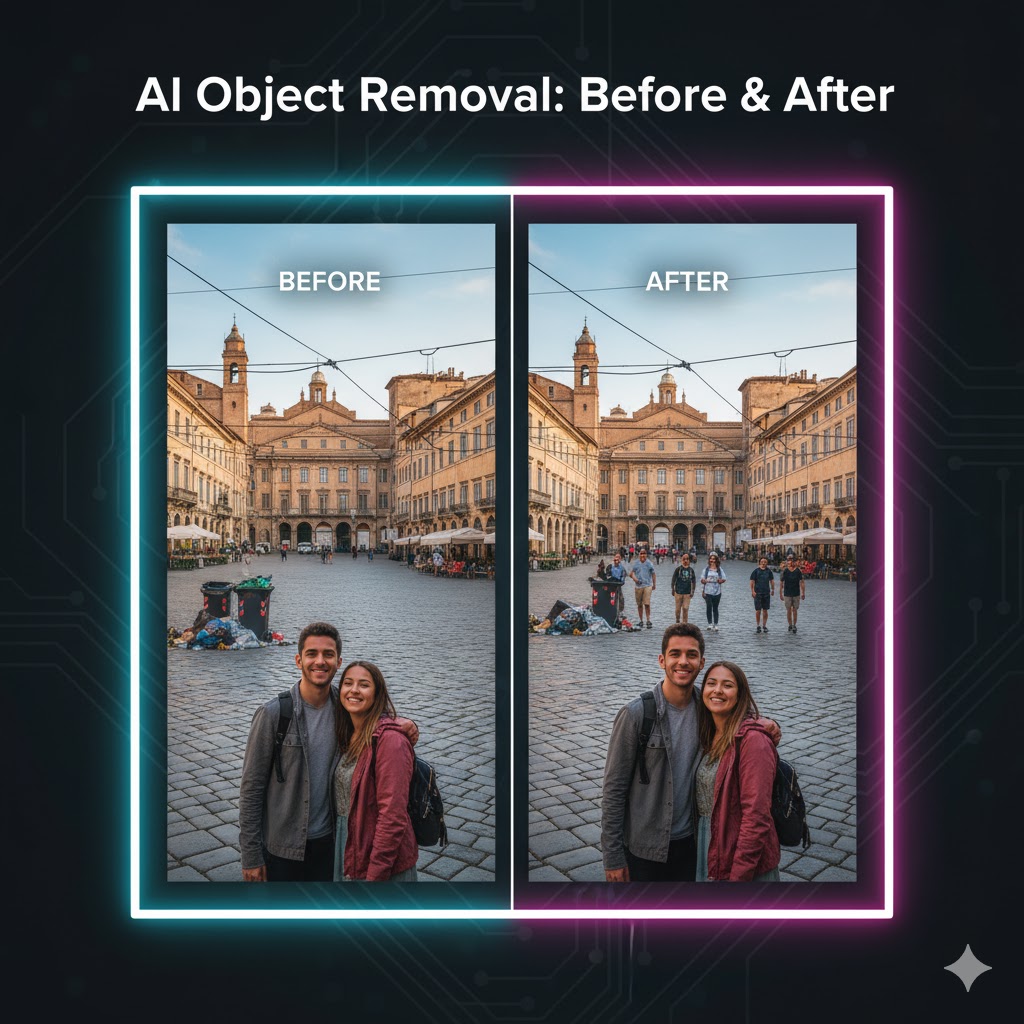
The battle for smartphone supremacy is no longer fought over megapixel counts; it’s won in the software. Today’s mobile photography is dominated by computational photography—the use of sophisticated algorithms to process and enhance images after the shutter clicks. Leading this charge is a new generation of Smartphone Photography AI Editing Tools that are fundamentally changing what users can do with a standard photo.
These tools, popularized by Google’s Magic Editor and Samsung’s Generative Edit, allow users to move subjects, remove entire crowds, and fill in missing backgrounds with hyper-realistic AI-generated content. This level of creative control, once reserved for professional desktop software like Photoshop, is now in everyone’s pocket. Our deep dive explores the current landscape of Smartphone Photography AI Editing Tools and their real-world impact on how we capture and share our memories.
2. The New Titans: Comparing Flagship AI Editing Tools
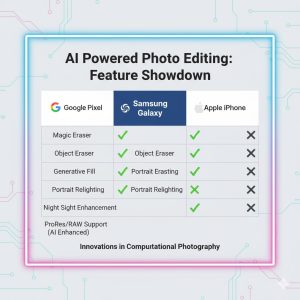
The three major smartphone ecosystems have adopted distinct, powerful approaches to on-device AI editing. The effectiveness of these Smartphone Photography AI Editing Tools relies heavily on the dedicated Neutral Processing Units (NPUs) found in the latest flagship chips (Tensor G5, Snapdragon 8 Gen 4, etc.).
A. Google’s Magic Editor (Pixel Series)
Google pioneered the space with its suite of “Magic” tools. The latest version of the Magic Editor is arguably the most user-friendly. Its most advanced feature is “AI Relighting,” which allows users to virtually change the direction and intensity of light on a portrait after the photo has been taken, adding a studio-quality finish. The underlying strength is the Tensor chip’s local processing, which handles complex object recognition and semantic segmentation quickly.
B. Samsung’s Generative Edit (Galaxy S Series)
Samsung’s approach, often bundled under the “Galaxy AI” umbrella, focuses heavily on Generative Fill. When a user circles a subject and moves it, the Generative Edit instantly fills the resulting empty space with AI-generated textures that blend seamlessly. Samsung’s tool is highly effective at complex background replacement, such as changing a cloudy sky to a sunny one while maintaining realistic reflections on water or glass.
C. Apple’s AI Clean-Up (iPhone Series)
While Apple tends to be more subtle, their latest updates integrate powerful AI cleaning tools directly into the default Photos app. While lacking the headline-grabbing ‘Generative Fill,’ Apple excels at “Smart Noise Reduction” in low-light photos and “Semantic De-Cluttering,” which subtly removes small, distracting elements (like trash cans or signage) in the background without user input, focusing on aesthetic improvement rather than dramatic transformation.
3. The Practical Revolution: Beyond Object Removal
The real value of these Smartphone Photography AI Editing Tools lies in solving common user frustrations, making every photo instantly “shareable” without professional skill.
- Fixing the Unfixable: How many great vacation photos are ruined by a random person walking into the background? These tools make removing large, complex objects (tourists, cars, power lines) a two-second job.
- Aspect Ratio Adaptation: A user can now crop a perfect horizontal photo to a vertical Instagram Story size, and the AI will intelligently fill in the missing top and bottom sections of the image, ensuring the original composition is maintained.
- Focus Correction: The AI can retrospectively correct slight misfocus errors in portraits, particularly useful for fixing images where the autofocus slightly missed the eye.
4. Technical and Ethical Considerations of AI Editing
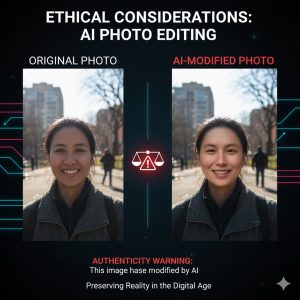
The proliferation of these tools introduces new challenges that consumers are starting to debate:
- The Reality Problem: As Smartphone Photography AI Editing Tools become more sophisticated, the line between an actual photograph and an AI-fabricated image is blurring. This raises ethical questions about authenticity, especially when sharing news-related or personal documentary content.
- Processing Power Demand: Running these high-level generative AI functions requires immense processing power. While the dedicated NPUs make them fast, constant use can still drain battery life rapidly and generate significant heat, especially on older devices.
- Cloud Dependence: While some basic functions run entirely on the device (on-device AI), the most complex generative fill tasks often require a brief connection to the cloud (cloud AI). This impacts user data privacy and speed, leading to ongoing consumer scrutiny over which data leaves the phone.
5. Final Verdict: Creativity Unlocked
The new generation of Smartphone Photography AI Editing Tools represents a monumental leap in mobile creativity. They have successfully democratized high-level image manipulation, making professional-grade fixes and creative alterations accessible to anyone with a modern phone.
The competition between Google, Samsung, and Apple is currently fierce, benefiting the consumer with faster, smarter, and more powerful tools with every release. While the ethical concerns surrounding authenticity will continue to evolve, the ability of these tools to rescue, enhance, and transform cherished memories makes them the most valuable software upgrade in the mobile space this year.
REALUSESCORE.COM Analysis Scores: Smartphone Photography AI Editing Tools
| Metric | Score (out of 10.0) | Note |
| Ease of Use & Accessibility | 9.8 | Simple interface makes professional edits accessible to all users. |
| Generative Quality & Realism | 9.5 | High realism in filling gaps and generating new backgrounds. |
| Speed & On-Device Processing | 8.5 | Fast on modern NPUs, but complex tasks still rely on cloud AI. |
| Ethical/Authenticity Risk | 6.5 | Low score reflects the growing public concern over image manipulation. |
| Consumer Value Proposition | 9.7 | Massive value addition; truly fixes previously unfixable photos. |
| REALUSESCORE.COM FINAL SCORE | 9.0 / 10 | Editor’s Choice – The most transformative software feature of the year for consumer photography. |