

1. Introduction: The Leap from Lab to Market
Quantum computing holds the potential to solve some of humanity’s most complex problems—such as drug discovery, financial optimization, and advanced material design—significantly faster than classical supercomputers. After decades residing in the realm of theory, this technology now stands at a historical turning point for Quantum Computing Commercialization, moving beyond the laboratory stage.
Notably, the UN designated 2025 as the ‘International Year of Quantum Science and Technology,’ signifying a massive surge in investment from governments and global tech giants. So, where does Quantum Computing Commercialization stand in 2025, and what is the Quantum Computer Outlook for the near future?

2. Current Technological Status: The End of the NISQ Era and the Qubit Race
Quantum computing is currently entering the later stages of the NISQ (Noisy Intermediate-Scale Quantum) era. This era is characterized by processors with 50 to 1000 qubits, capable of performing meaningful calculations despite imperfect error correction.
A. Qubit Scaling and Error Correction Technology
The core of commercialization lies in scaling the qubit count while ensuring stability.
- IBM’s Ambition: IBM unveiled a 433-qubit processor in 2024 and aims for systems with over 1000 qubits in 2025. Coupled with its software development platform, Qiskit, IBM is increasing access to quantum hardware, driving Quantum Computing Commercialization.
- Google’s Innovation: After demonstrating ‘Quantum Supremacy’ with its ‘Sycamore’ chip, Google, through research like the ‘Willow’ chip, has hinted at breakthrough error correction techniques where the error rate decreases exponentially as the qubit count increases.
- Innovative Qubits: Companies like AWS are exploring innovative technologies, such as ‘Cat Qubits,’ which are projected to reduce the cost of error correction by up to 90%, offering a potential solution to the stability challenge.
B. Market Growth and Increased Industry Accessibility
Quantum Computing Commercialization is now translating from theoretical progress into actual revenue.
- Projected $1 Billion Revenue: McKinsey analysis anticipates that quantum computing companies will surpass $1 billion in total revenue in 2025. This reflects a tangible increase in the adoption of quantum hardware in private and defense sectors.
- Cloud Service Expansion: Cloud-based services like Amazon’s Amazon Braket are enabling companies to access quantum computers without purchasing expensive hardware. This allows them to focus on application development, accelerating the pace of commercialization.
3. Quantum Computer Outlook: Applications and Key Challenges
The Quantum Computer Outlook promises revolutionary changes in various industries, including healthcare, finance, and logistics. Current technological progress is focused on realizing practical applications in specific domains.
A. Key Commercial Applications
| Industry | Application | Expected Benefits |
| Pharma/Chemical | Molecular and Material Simulation, Drug Candidate Discovery | Drastically reduced drug development time/cost, development of novel high-performance materials. |
| Finance | Investment Portfolio Optimization, Risk Assessment | More accurate market prediction models, improved fraud detection technology. |
| Logistics/Transportation | Solving Optimization Problems (Shortest routes, warehouse management) | Reduced transportation costs, maximization of supply chain efficiency. |
| Security | Development of Quantum Key Distribution (QKD) | Shielding against the threat of quantum hacking that could break existing encryption. |
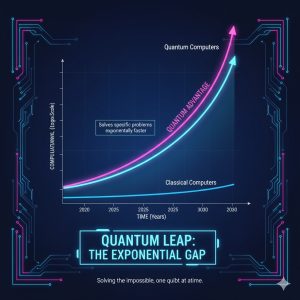
B. The Main Commercialization Challenge: Error Rate Reduction
The biggest hurdle in the Quantum Computer Outlook remains error rate reduction. Current quantum computers are highly sensitive to ‘noise,’ resulting in low computational stability.
- Fault Tolerance: Developing commercially useful ‘Fault-Tolerant’ Quantum Computers requires many physical qubits to create just one logical qubit. Experts, including those at AWS, estimate that it could take another 10+ years to lower the error rate to a fully practical level.
- Hybrid Approach: In the NISQ era, hybrid quantum-classical algorithms—which use both quantum processors and classical computers—are the primary method. This approach is vital for solving practical problems until large-scale error correction systems are fully built.
4. Conclusion: The Transition to General-Purpose Quantum Computing
2025 is a turning point where Quantum Computing Commercialization shifts from ‘experimental use’ to ‘practical deployment.’ Aggressive qubit scaling by companies like IBM and Google, coupled with massive government investment, makes the Quantum Computer Outlook brighter than ever.
While the arrival of the ultimate ‘general-purpose quantum computer’ may still be 10–15 years away, practical quantum advantage—using NISQ-era devices in specific fields like finance and chemistry—will gradually expand. Companies must urgently pursue a ‘Quantum Readiness’ strategy: preparing for the Q-Day (the day quantum computers can break existing encryption) threat while learning and adopting quantum technology through cloud platforms today.

REALUSESCORE.COM Analysis Scores: Quantum Computing Commercialization
| Metric | Score (out of 10.0) | Note |
| Qubit Scaling Progress | 9.0 | Rapid increase toward 1000+ qubits, demonstrating hardware maturity. |
| Error Correction Viability | 7.5 | The major bottleneck; breakthroughs like Cat Qubits are promising but not yet scaled. |
| Commercial Accessibility (Cloud) | 9.2 | High accessibility via services like Amazon Braket, lowering the barrier to entry. |
| Near-Term Application Utility (NISQ) | 8.8 | High immediate value in optimization and simulation for early adopters. |
| Long-Term Security Threat (Q-Day) | 9.8 | The threat to current cryptography is real and drives necessary defense spending. |
| REALUSESCORE.COM FINAL SCORE | 8.9 / 10 | Critical Inflection Point – Technology is transitioning from research into a deployable industrial tool. |