
1. The Digital Transformation Bottleneck
In the era of rapid digital transformation, businesses need to develop and deploy applications faster than ever to meet market demands. However, traditional application development is bottlenecked by two critical factors:
-
Talent Shortage: The severe global shortage of skilled professional software developers.
-
IT Backlog: The overwhelming queue of application requests waiting on central IT teams, leading to delayed project delivery and missed business opportunities.
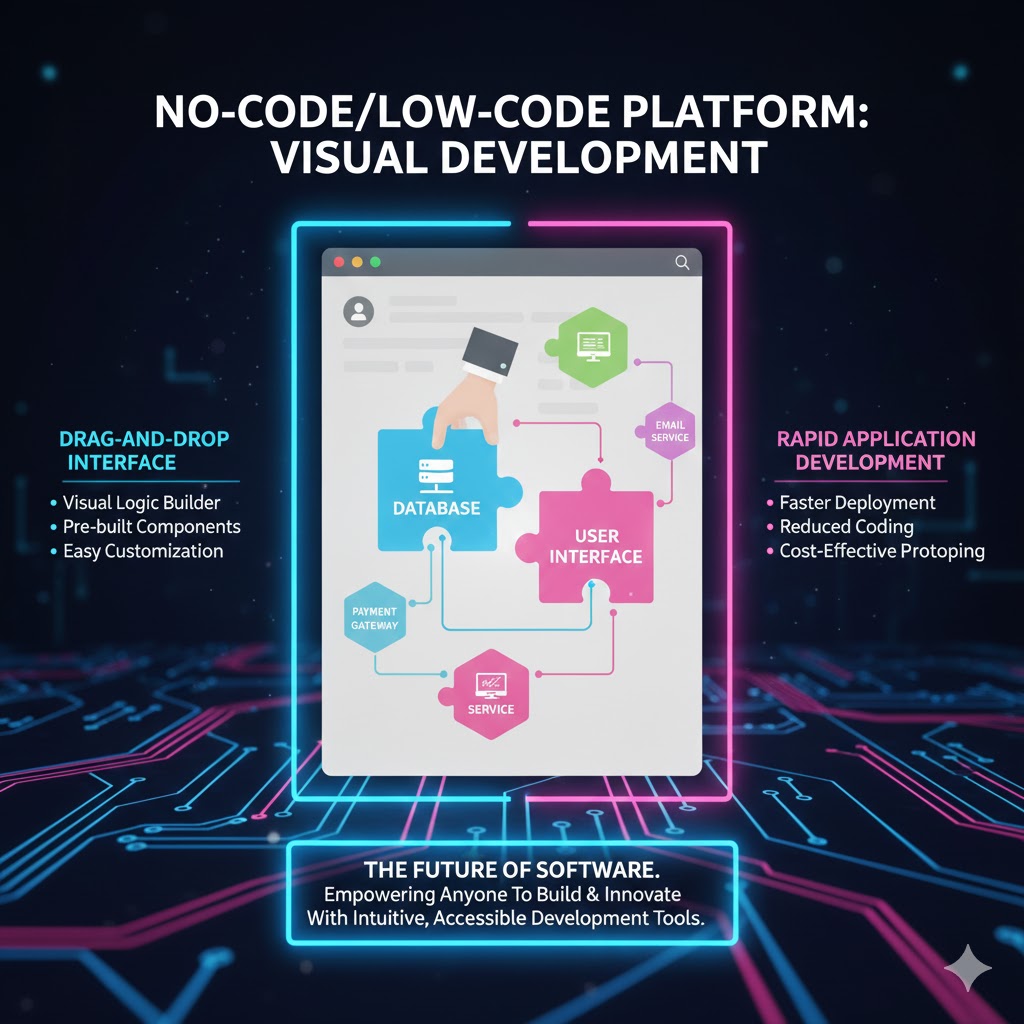
No-Code/Low-Code (NC/LC) platforms have emerged as the primary solution to these bottlenecks. They offer a visual, drag-and-drop interface that dramatically lowers the technical barrier to entry, enabling a broader set of employees—known as Citizen Developers—to create functional business applications.
| Platform Type | Target User | Focus | Code Output | Speed of Development |
| No-Code | Business Users (Citizen Developers) | Simplicity, UI/UX-focused applications | Zero custom code | Extremely Fast |
| Low-Code | Power Users, Professional Developers | Extensibility, Complex workflows, Integration | Minimal custom code (for integration/custom logic) | Very Fast |
2. Democratizing Development and the Rise of the Citizen Developer
The most profound impact of NC/LC platforms is the democratization of application development. By simplifying the process, they empower users closest to the business problem to build their own solutions, a movement critical for enterprise agility.
A. Empowering Business Domain Experts
Citizen Developers—employees working in sales, HR, or operations—possess deep knowledge of their specific workflows but may lack coding skills. NC/LC tools allow them to rapidly:
-
Automate Workflows: Build customized approval processes, forms, and data collection systems.
-
Create Data Dashboards: Visualize domain-specific data without waiting for IT resources.
-
Develop Mobile Apps: Quickly deploy simple internal mobile applications for field service or internal communication.
B. Alleviating IT Burden and Fostering Collaboration
NC/LC does not eliminate professional developers; rather, it allows them to shift focus to high-value, complex projects:
-
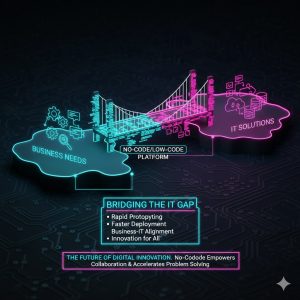
IT Focus: Professional developers use Low-Code tools to rapidly build the foundational blocks (APIs, complex integrations, core services) that Citizen Developers then assemble and customize using No-Code tools.
-
Platform Governance: Central IT establishes the governance framework, security policies, and standard components, ensuring that applications built by Citizen Developers remain compliant, secure, and scalable.
3. Technical Role of NC/LC in the Enterprise Stack
Modern NC/LC platforms are sophisticated tools designed for enterprise scale, not just simple prototyping. They must address security, integration, and performance.
A. Integration and Legacy Systems
A key technical hurdle for any new application is integrating with existing legacy systems (e.g., SAP, Oracle, custom APIs). Low-Code platforms excel here by offering:
-
Pre-built Connectors: Standardized interfaces for common enterprise systems.
-
API Management: Tools for developers to easily expose internal data and services as reusable APIs for Low-Code consumption.
B. Scaling and Deployment
Enterprise applications require robust deployment and scaling capabilities. Modern NC/LC platforms integrate seamlessly with cloud-native infrastructure, often abstracting away the complexities of:
-
Containerization: The underlying application logic may run within containers (like Docker or Kubernetes), managed entirely by the platform.
-
Serverless Architecture: Many NC/LC functions are executed using serverless computing models, ensuring automatic scaling and pay-as-you-go efficiency.
The comparison between serverless and containerization architectures is a major consideration for optimizing Total Cost of Ownership (TCO) in IT, a challenge mirrored by the need to efficiently manage NC/LC applications. For a relevant technical TCO analysis on infrastructure choices, see our analysis on: Serverless Architecture vs. Containerization (Kubernetes): A TCO Analysis for AI Workloads.
4. Governance and the Risk of ‘Shadow IT’
While NC/LC platforms enable speed, they introduce the risk of “Shadow IT”—unmanaged applications built outside of IT oversight. Effective governance is non-negotiable for enterprise success.
-
Federated Governance Model: The best strategy is a federated model where the central IT team dictates the rules (security, data access, architecture standards) but the individual domain teams (Citizen Developers) are accountable for the execution and quality of their applications. This approach balances speed with control.
-
Automated Security Scans: Platforms must include automated checks for security vulnerabilities and compliance mandates before an application can be deployed.
-
Centralized App Catalog: Maintaining a centralized repository (or catalog) of all NC/LC applications ensures visibility, prevents duplication of effort, and facilitates management, monitoring, and eventual decommissioning.
5. Conclusion: The Hybrid Development Future
No-Code/Low-Code is not a temporary trend; it is the foundation of the future hybrid development model. By 2030, analysts predict that NC/LC development will account for the majority of all new enterprise applications.
The successful enterprise will strategically combine the speed of the Citizen Developer with the governance and scaling expertise of the professional IT team, transforming software development from an exclusive craft into a pervasive, decentralized capability critical for sustained competitive advantage.
REALUSESCORE Analysis Scores
Analysis of the impact and maturity of No-Code/Low-Code platforms in the enterprise:
| Evaluation Metric | Application Development Speed | Democratization/Accessibility | Integration with Legacy Systems | Governance and Security Maturity |
| Current Platform Maturity | 9.8 | 9.5 | 8.5 | 8.0 |
| Organizational Adoption Challenge | 8.5 | 9.0 | 7.5 | 9.0 |
| REALUSESCORE FINAL SCORE | 9.6 | 9.3 | 8.0 | 8.5 |