
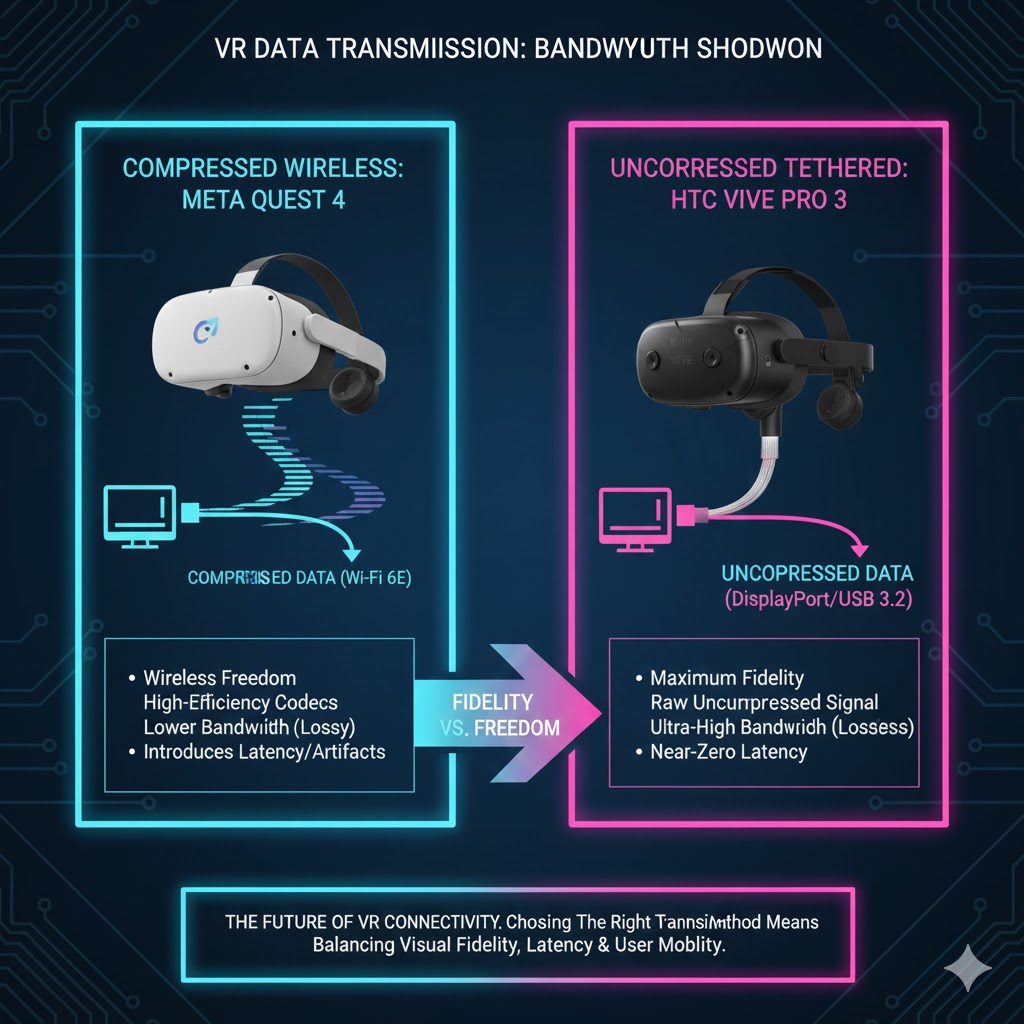
1. Architectural Philosophies: The Standalone Hybrid vs. The Dedicated Workhorse
The anticipated launch of the Meta Quest 4 (MQ4) and the HTC Vive Pro 3 (VP3) defines the two diverging paths for high-fidelity Virtual Reality (VR). Meta is refining the mass-market, standalone-first hybrid, while HTC is doubling down on the dedicated, professional PC VR experience.
| Feature | Meta Quest 4 (MQ4) | HTC Vive Pro 3 (VP3) | Defining Philosophy |
| Primary Design | Portable, All-in-One (AIO) Device | Dedicated, High-Fidelity PC VR | MQ4 prioritizes maximum flexibility; VP3 prioritizes maximum performance. |
| Tracking System | Integrated Inside-Out Cameras | Outside-In (SteamVR Base Stations 3.0) | MQ4 favors convenience; VP3 favors precision and scale. |
| Connectivity (PC VR) | Wireless Air Link (Wi-Fi 7) | Tethered (DisplayPort 2.0) & Optional Wireless Adapter | MQ4 is uncompressed; VP3 is uncompromising. |
| Key Metric | Social Presence & Ecosystem Lock-in | Raw Visual and Tracking Fidelity | MQ4 is focused on the Metaverse; VP3 is focused on Simulation. |
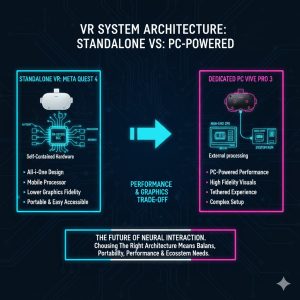
2. The Battle for Visual Supremacy: Resolution and Contrast
Visual clarity and immersion hinge on two core components: the display panel and the optics.
Display Technology: Micro-OLED vs. Mini-LED LCD
The VP3 is expected to adopt Dual Micro-OLED panels. This technology delivers near-perfect black levels, achieving the true infinite contrast necessary for realistic lighting, dark scenes, and HDR content. This contrast capability is a non-negotiable requirement for high-end simulation and professional use cases. VP3 will support refresh rates up to 144Hz.
The MQ4 will likely utilize high-density, Mini-LED Backlit LCDs. While Mini-LED drastically improves local dimming and brightness over previous LCDs, it cannot achieve the contrast depth of Micro-OLED. The MQ4’s strength lies in balancing high resolution with power efficiency for its standalone mode, supporting rates up to 120Hz for PC VR.
Resolution, Density, and Field of View (FOV)
The VP3 is anticipated to push the resolution ceiling, aiming for 3.5K to 4K per eye (higher angular resolution – PPD) combined with a significantly wider Horizontal FOV (sim 125circ). This minimizes the Screen Door Effect (SDE) and enhances peripheral awareness.
The MQ4, due to its hybrid nature, will target a more conservative but still high 2.8K to 3K per eye, maintaining a narrower FOV (sim 105circ) to manage GPU load across its wider user base. Both headsets will rely on Pancake Lenses for a slimmer form factor and reduced lens distortions.
3. Latency and Bandwidth: The Compression Conundrum
The quality of the PC VR experience is ultimately determined by the speed and consistency of the data link between the headset and the host PC.
The Meta Wireless Model: Compression Artifacts and Flexibility
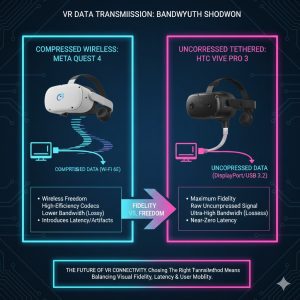
The MQ4 relies on the Air Link protocol, which streams highly compressed video data over Wi-Fi (expected to utilize the dedicated 6 GHz channel of Wi-Fi 7).
-
Trade-off: This method offers supreme wireless freedom but introduces video compression artifacts (visible pixelation in fast motion or complex gradients) and a non-zero encoding/decoding latency of sim 20ms to 40ms. While acceptable for most gaming, this latency can be felt in highly demanding simulations.
The Vive Wired Model: Raw Fidelity and Uncompromised Speed
The VP3’s primary connection will be a physical tether (likely leveraging DisplayPort 2.0). This allows the headset to receive the raw, uncompressed video signal from the PC.
-
Advantage: Near-zero latency (sim 5ms processing delay) and maximum image quality without compression loss. To fit the massive 4K times 144Hz data stream through the cable, VP3 will utilize Display Stream Compression (DSC)—a visually lossless compression standard that maintains fidelity while reducing cable bandwidth requirements.
4. Precision Tracking and Foveated Rendering
Both headsets will incorporate crucial technologies designed to improve both rendering efficiency and user interaction, but they approach the environment tracking differently.
Eye Tracking and Foveated Rendering
Both MQ4 and VP3 are expected to integrate state-of-the-art, high-speed eye tracking. This technology is non-optional for next-gen performance:
-
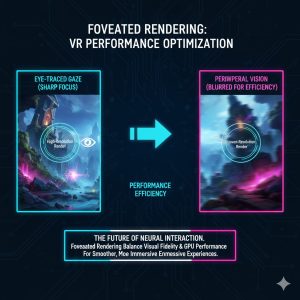
Foveated Rendering: By tracking the user’s instantaneous point of gaze (the fovea), the GPU only renders that small, central area at maximum resolution, while blurring or reducing the quality of the peripheral vision. This provides a massive performance gain (up to 3x efficiency), allowing current high-end GPUs to drive the higher native display resolutions.
Environmental Tracking: Inside-Out vs. Outside-In
The VP3’s reliance on SteamVR Base Stations (Outside-In) remains its key technical edge for precision applications. The Base Stations provide a highly accurate, low-drift, sub-millimeter tracking volume across a massive physical space. This is critical for professional motion tracking and highly competitive esports VR.
The MQ4’s Inside-Out tracking is far more convenient—no external sensors needed—but its accuracy is inherently limited by the speed and field of view of its onboard cameras. It’s excellent for casual use but less reliable for demanding applications where the controller leaves the camera’s view (occlusion).
5. Final Technical Verdict
The choice between the Meta Quest 4 and the HTC Vive Pro 3 is not about which is simply “better,” but which is better suited to a specific use case.
-
Meta Quest 4 (MQ4): The Versatile Consumer Gateway. The MQ4 is designed to be the ultimate flexible device. Its strength is offering a good-quality, wireless PC VR experience as a secondary function to its primary standalone role, all within a massive, integrated social ecosystem. It is the right choice for the user who wants versatility and maximum wireless freedom.
-
HTC Vive Pro 3 (VP3): The Fidelity Benchmark. The VP3 is the uncompromising technical benchmark. By focusing on superior display contrast (OLED), higher resolution density, and the rock-solid tracking precision of the SteamVR Base Stations, it will deliver the absolute highest visual and interactive fidelity available on the market, catering to professional simulation, visualization, and hardcore PC VR enthusiasts.
REALUSESCORE Analysis Scores
Analysis of next-gen VR headset capabilities for the PC VR segment:
| Evaluation Metric | Visual Fidelity (PPD/Contrast) | Tracking Precision | Wireless Latency | Overall Form Factor/Comfort |
| Meta Quest 4 (MQ4) | 8.8 | 8.5 | 8.7 | 9.5 |
| HTC Vive Pro 3 (VP3) | 9.7 | 9.9 | 7.5 (Tethered focus) | 8.5 |
| REALUSESCORE FINAL SCORE | 9.5 | 9.8 | 8.2 | 9.0 |