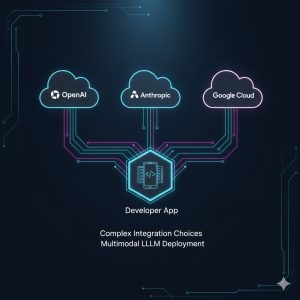
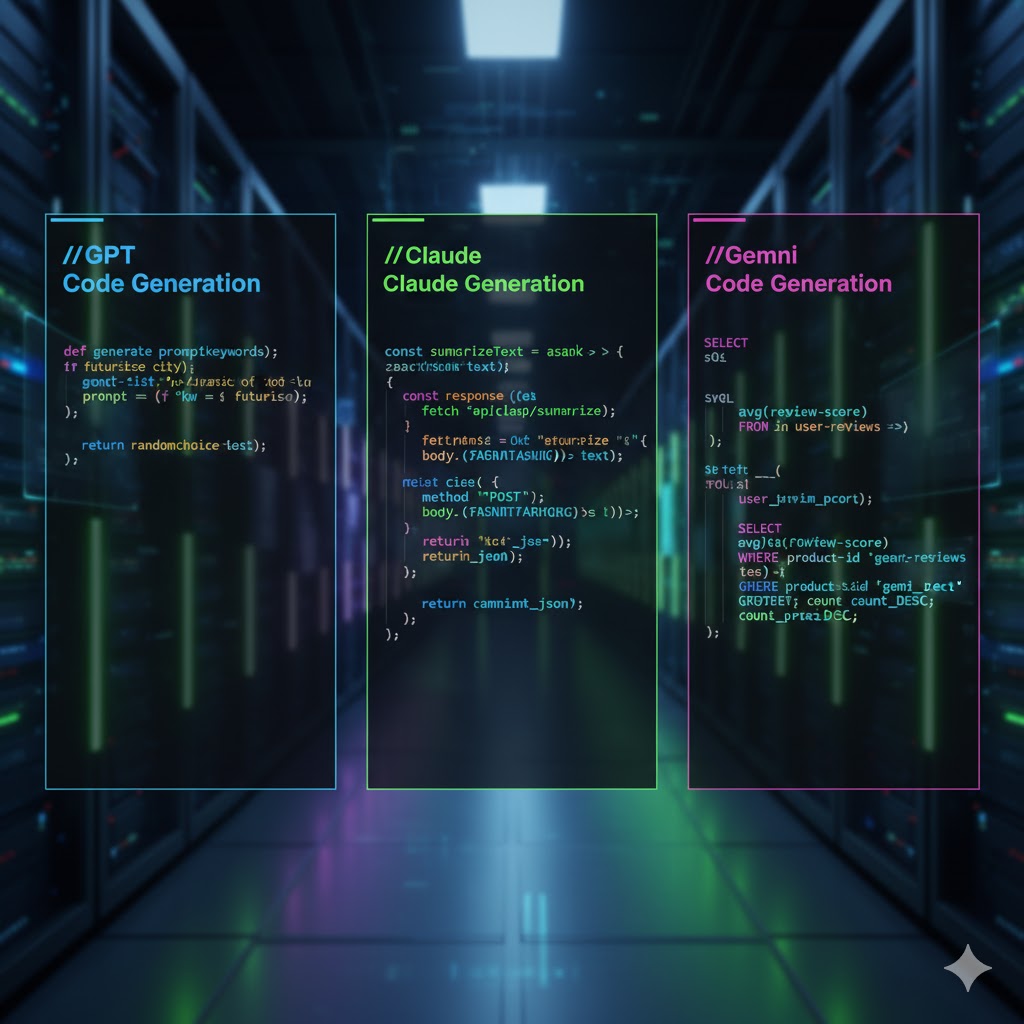
The choice of a Large Language Model (LLM) is the foundational decision for any modern application. In 2025, three giants dominate the API landscape: OpenAI’s GPT family, Anthropic’s Claude Sonnet, and Google’s Gemini lineup. For developers building agents, complex coding tools, or high-volume enterprise applications, picking the right engine is everything.
This comparison is the definitive guide to choosing the best LLM for Developers GPT vs Claude vs Gemini, focusing on specialization, performance, and cost-effectiveness.
1. Specialization & Core Competency
The “best” model is the one that is best for the task. The market has shifted from generalists to specialists.
| Model Family | Core Strength (Developer Focus) | Ideal Use Case |
| Claude Sonnet (4.5) | Complex Reasoning & Agentic Coding | Multi-step task execution, complex code refactoring, system architecture design. |
| GPT Models (GPT-5/4o) | Versatility, Logic, & Ecosystem | Full-stack development, API integration, debugging, general-purpose content generation. |
| Gemini (Pro/Flash) | Massive Context & Data Workflow | Processing entire codebases, research, data analysis, Google ecosystem integration. |
- Claude Sonnet: Claude 4.5 Sonnet has frequently been cited as the world’s leading model for coding accuracy and agentic orchestration. Developers praise its ability to plan and execute multi-step processes effectively, often producing cleaner, production-grade code.
- GPT Models: GPT-5 (and its predecessors like 4o) remains the gold standard for logical consistency and all-around reliability. It excels at traditional deductive reasoning and provides the most comprehensive toolkit for general development tasks across various languages and frameworks.
- Gemini: Gemini 2.5 Pro’s unique strength lies in its massive context window (up to 2 million tokens), making it peerless for research, deep document analysis, and handling entire multi-file repositories in a single conversation.
2. Performance Metrics: Context, Speed, and Cost
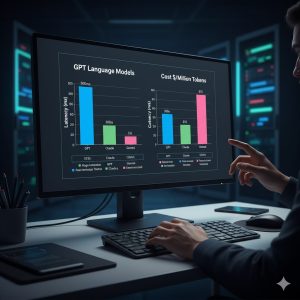
Choosing the right LLM for Developers GPT vs Claude vs Gemini often comes down to balancing cost and speed.
2.1 Context Window & Codebase Handling
| Model | Standard Context Window (Tokens) | Key Advantage |
| Gemini 2.5 Pro | 1,000,000+ | Can process entire codebases or research papers instantly. |
| Claude Sonnet 4.5 | 200,000 | Excellent for detailed technical documentation and long-form code explanations. |
| GPT-5 | 400,000 | Robust capacity for advanced multi-document synthesis and project management. |
2.2 Cost-Effectiveness and Latency
The Flash and Mini variants are critical for production speed and budget efficiency.
- Speed (Latency): Gemini 2.5 Flash is highly optimized for low latency and is often the fastest model available for real-time applications and high-frequency tasks.
- Cost: Models like GPT-4o Mini and Gemini 2.5 Flash are remarkably cheap, often costing only fractions of a dollar per million tokens, making them ideal for budget-conscious batch processing or applications where speed is paramount.
- Quality vs. Cost: Claude Sonnet, while slightly more expensive and generally slower than the budget tiers, offers a superior quality-per-token for tasks requiring high technical accuracy and minimal hallucinations.
3. API & Ecosystem Integration
The platform and developer tools surrounding the model significantly impact ease of integration and deployment.
| Ecosystem | API Strengths for Developers | Integration Example |
| OpenAI (GPT) | Best established plugin ecosystem, comprehensive API documentation, seamless integration with Microsoft (Copilot). | Building custom GPT Agents or integrating with GitHub Copilot. |
| Anthropic (Claude) | Strong focus on safety/ethical controls, “Artifacts” (visualized, runnable outputs), robust internal tool use. | Deploying LLMs in highly regulated or educational environments. |
| Google (Gemini) | Strongest native integration with cloud services (Vertex AI) and Google Workspace (Docs, Sheets). | Real-time data analysis, integrating AI features directly into enterprise tools. |
4. The Developer’s Verdict: Choosing Your Engine
The best LLM for Developers GPT vs Claude vs Gemini is highly dependent on the project requirements. Stop looking for the “perfect” model; instead, match the model to the task.
| Developer Persona | Recommended Model(s) | Why? |
| The Agent Builder | Claude Sonnet 4.5 | Superior reasoning, planning, and code quality for autonomous execution. |
| The Full-Stack Generalist | GPT-5 / GPT-4o | Unmatched versatility, excellent debugging capabilities, and comprehensive framework support. |
| The Data Analyst / Researcher | Gemini 2.5 Pro | Massive context window for synthesizing large codebases, papers, and data sets. |
| The Cost-Focused Engineer | Gemini 2.5 Flash / GPT-4o Mini | Highest speed and lowest cost per token, perfect for high-volume, low-latency applications. |
🟪 Autonomous digital workers framework comparison
Summary Table: Key Developer Specifications
| Feature | Claude Sonnet 4.5 | GPT-5 / GPT-4o | Gemini 2.5 Pro |
| Coding Accuracy | Highest (Agentic Tasks) | Excellent (Logic & Refactoring) | Strong (Algorithmic Tasks) |
| Max Context Window | 200K | 400K | 1M – 2M (Largest) |
| Best for | Code Quality, Reasoning, Safety | Versatility, Debugging, Ecosystem | Large Context, Data Analysis, Research |
| Cheapest Tier | Claude Haiku | GPT-4o Mini | Gemini 2.5 Flash |
| Key Differentiator | Clean, well-documented code output | Most comprehensive API/Tooling | Unparalleled data ingestion capability |