
Efficiency vs. Resilience: The Great Tech Supply Chain Rewiring and Its $500 Billion Cost
The technology industry, once a beacon of frictionless globalization and relentless cost-optimization, now finds itself at the epicenter of a geopolitical storm. Trade Wars and Tariffs are no longer abstract policy tools; they are the primary forces driving the most significant re-engineering of the Tech Supply Chain since the advent of global manufacturing. For executives and investors, the calculus has fundamentally shifted: ruthless efficiency is yielding to resilience, and lowest cost is being replaced by security of supply. This transformation, spearheaded by the U.S.-China technology rivalry, is imposing tangible costs—estimated to be a cumulative $500 billion in extra spending on diversification and inefficient manufacturing by 2030—and forcing a strategic reorientation across the entire technology ecosystem.
1. The Semiconductor Chokepoint: Where Geopolitics Meets Hardware
The semiconductor industry—the foundation of all modern technology, from AI to smartphones—is the most dramatic battlefield in the geopolitical tech conflict, demanding an exhaustive analysis of the risks.
Weaponization of Export Controls and the Dual-Use Dilemma
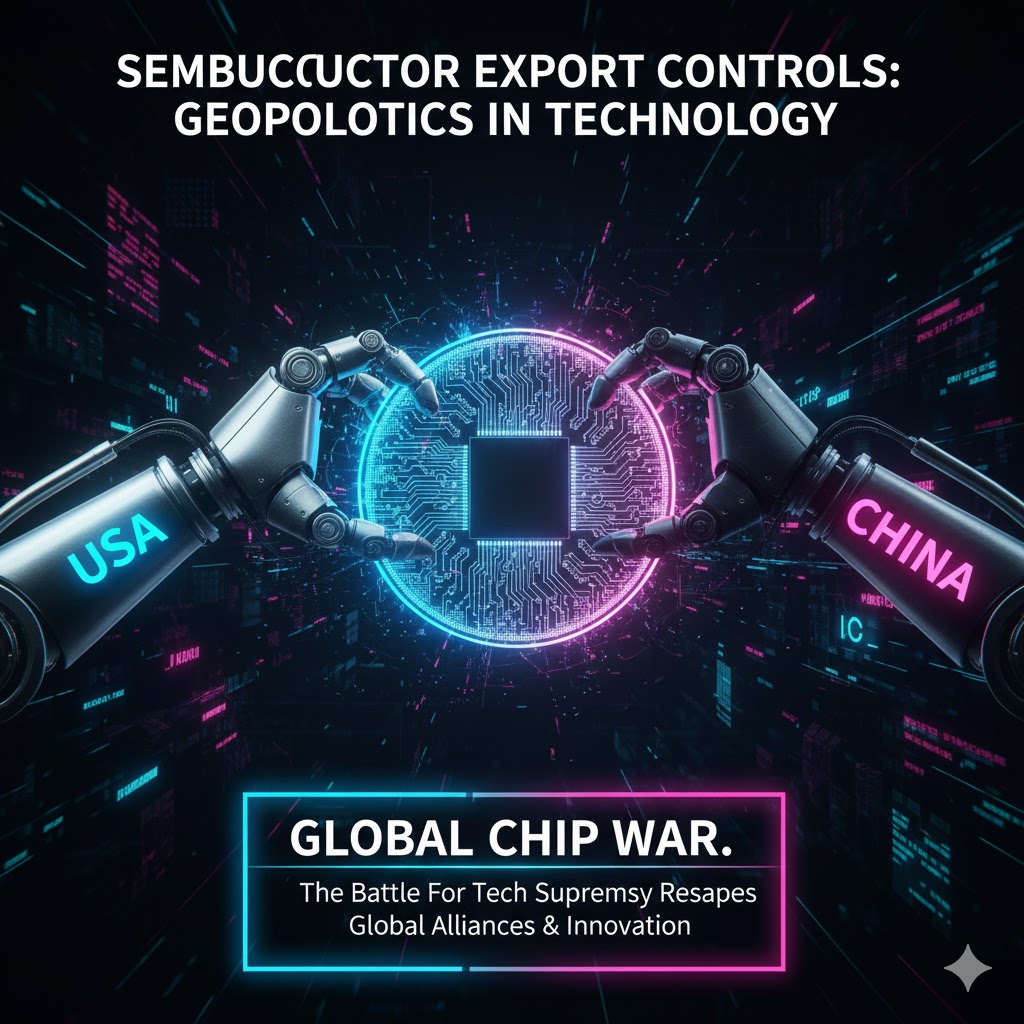
The primary tool used in the tech trade war is not just tariffs on finished goods, but devastating export controls on critical technologies and specialized equipment, specifically targeting advanced computing.
-
Targeting the Manufacturing Core: The U.S. has imposed severe restrictions on the sale of advanced AI chips (like NVIDIA’s flagship data center GPUs) and the highly specialized equipment (from companies in the U.S., Japan, and the Netherlands) required to manufacture leading-edge semiconductors 2.3, 2.4. This is a deliberate “choke point” strategy.
-
The Dual-Use Precedent: These restrictions are justified on national security grounds, targeting “dual-use technologies”—those with both critical commercial and military applications 4.1. By constraining access to advanced computing power, the goal is to hobble a rival’s ability to advance in crucial fields like Generative Artificial Intelligence, hypersonic defense, and advanced computing, thereby altering the global balance of power 1.4, 2.5.
-
Forcing Decoupling: The immediate consequence is a forced fragmentation: the creation of two parallel, rapidly decoupling semiconductor ecosystems—one led by the U.S. and its allies (Japan, South Korea, Taiwan), and one driven by China’s accelerated national strategy for self-reliance (“Made in China 2025”) 2.5. This division complicates everything from software development standards to hardware compatibility.
Tariffs, Inventory, and Price Volatility
While export controls restrict technology transfer, direct tariffs on goods flowing between major economic blocs directly impact profitability and consumer pricing.
-
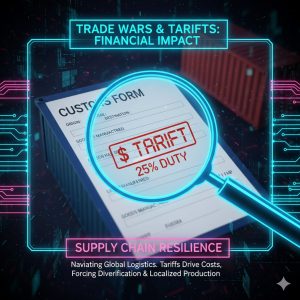
Increased Input Costs: The imposition of tariffs—sometimes as high as 25% on hundreds of billions of dollars worth of goods—raises the cost of intermediate inputs and capital goods, ultimately increasing the consumer price of everything from smartphones to data center servers 1.2, 3.4.
-
Uncertainty and Stockpiling: The constant threat of new tariffs or policy shifts introduces extreme uncertainty, forcing multinational corporations (MNCs) like Apple and major automotive manufacturers to stockpile critical components (like legacy chips and processors) as a defensive measure 2.2, 2.5. This strategic stockpiling inflates inventory costs, ties up capital, and can create artificial market shortages.
2. The Great Supply Chain Rewiring: Reshoring and Strategic Diversification
The sustained pressure from Trade Wars and Tariffs is compelling MNCs to completely rethink their established, single-source supply networks, moving away from a model optimized solely for the lowest manufacturing wage.
The Rise of ‘Friend-Shoring’ and ‘Near-Shoring’
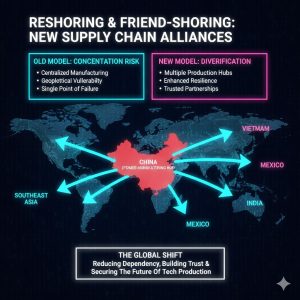
Companies are actively shifting production out of single, politically sensitive regions to mitigate risk, resulting in a global “rewiring” that seeks geopolitical alignment over absolute cost.
-
Diversification of Final Assembly: Tech giants like Apple, Google, and Samsung have aggressively diversified their final assembly operations, moving significant segments of production (especially high-volume assembly of smartphones and peripherals) to politically stable partners like Vietnam, India, and Mexico 1.3, 1.5. This strategic move drastically reduces vulnerability to a single geopolitical flashpoint and tariff shock 1.3.
-
Geographic Shifts: India, in particular, has emerged as a major winner, capturing a rapidly increasing share of global smartphone assembly thanks to government incentive schemes and its perceived stability. Mexico is gaining ground in automotive and complex electronics manufacturing due to its proximity to the U.S. market (Near-Shoring) 1.3, 4.2.
-
The Cost of Resilience: This diversification is not cheap. New facilities and supply chains are often less efficient and more costly than established Chinese operations. The premium paid for this resilience is a direct geopolitical tax on the tech industry, a cost that will eventually be passed to consumers 2.3.
Government-Backed Reshoring: The Industrial Policy Revival
Policy is now driving market change, using massive subsidies to rebuild domestic manufacturing capabilities.
-
The CHIPS Act and EU Chips Act: These sweeping legislative acts in the U.S. and Europe are providing billions of dollars in subsidies and tax breaks to incentivize the building of expensive, cutting-edge semiconductor fabrication plants (fabs) domestically 2.3, 4.4.
-
The Cost-Security Trade-Off: While this increases national security, the cost of production in these locations is significantly higher—estimates suggest it can be up to 50% more expensive to make leading-edge chips in the U.S. compared to Taiwan 2.3. Governments are making a strategic decision that the cost of guaranteed, secure supply outweighs the cost of relying on a fragile or hostile external supply chain.
3. Structural Transformation and The New Global Tech Order
The long-term consequence of this geopolitical pressure is a structural change in how technology is developed, manufactured, and consumed, creating a fundamentally bifurcated global market.
The Bifurcation of Standards and Technologies
The decoupling in hardware is inevitably leading to a decoupling in software, standards, and component technologies.
-
Two Stacks: We are seeing the emergence of two separate technological stacks: one based on Western standards and components (secure supply) and another based on rapidly developed, self-sufficient Eastern standards 4.5. Companies may soon need to develop two distinct versions of their products to comply with regulatory and component availability differences in each market.
-
Innovation vs. Security: The focus on achieving self-sufficiency diverts billions of dollars and engineering talent away from basic research and frontier innovation toward building redundant, localized supply chains. This drag on R&D spending could potentially slow the pace of global technological advancement 2.5.
The Strategic Imperative: Mastering Geopolitical Agility
The future tech giants will not be defined solely by their R&D budget but by their Geopolitical Agility—the ability to swiftly adapt to regulatory and tariff changes.
-
Real-time Visibility and AI Simulation: Companies are investing heavily in digital supply chain technologies, using AI-driven scenario planning and real-time data analytics to model the impact of sudden tariff hikes or export control expansions 1.2, 1.3.
-
Localization (“In the Country, for the Country”): The trend toward strengthening local production capabilities to serve domestic markets is accelerating, reducing reliance on volatile global networks 4.5. This means building regional hubs that can function autonomously.
-
Public-Private Partnerships (PPPs): Governments and corporations are collaborating (e.g., through the CHIPS Act funding) to share risks, streamline regulatory processes, and ensure continuity of critical operations, a clear sign that national security and economic policy have merged 1.3, 4.4.
The Role of Geopolitics in Technology is now a core due diligence factor. Investors must favor companies that have demonstrably de-risked their supply chains, diversified their manufacturing bases, and secured long-term agreements with politically aligned trade partners. The new tech giants will be those that master not just innovation, but geopolitical risk management.
REALUSESCORE.COM Analysis Scores
| Evaluation Metric | Score (Out of 10.0) | Note/Rationale |
| Geopolitical Risk to Tech Supply Chain | 9.9 | Extreme due to the “chip war” and export controls on foundational technology 2.5. |
| Impact of Tariffs on Input Costs | 9.5 | Tariffs on intermediate and capital goods cause significant, cascading price increases 3.4. |
| Efficacy of Decoupling/Reshoring | 8.2 | High government funding, but high cost of production requires massive, sustained investment; multi-decade effort 2.3. |
| Supply Chain Diversification Trend | 9.8 | Strong, irreversible evidence of firms shifting assembly to Vietnam, India, and Mexico 1.3, 1.5. |
| Investor/Business Uncertainty | 9.7 | High policy volatility (tariffs, export controls) necessitates costly inventory stockpiling and operational redundancy 1.1, 4.4. |
| REALUSESCORE.COM FINAL SCORE | 9.6 / 10 | Geopolitics is the single largest factor driving the restructuring of the global tech supply chain, prioritizing security and resilience over pure efficiency at a cost of hundreds of billions of dollars. |