

1. Introduction: Google’s All-In AI Ecosystem
The era of Artificial Intelligence is no longer confined to chatbot interfaces. Google is aggressively integrating its powerful Gemini AI model across its entire ecosystem, transforming core products from a simple utility into an intelligent assistant. The most recent and impactful updates are the integration of Google Gemini AI into Google Maps and the significant upgrade to its Deep Research tool within Workspace.
These integrations fundamentally change how users plan, navigate, and synthesize information. For millions of professionals and daily commuters, this represents a massive shift in digital productivity. This review analyzes the real-world utility of these two key Gemini rollouts, exploring whether they deliver on Google’s promise of smarter, more conversational technology. The tone is friendly and professional8.
2. Gemini in Google Maps: Conversational Navigation
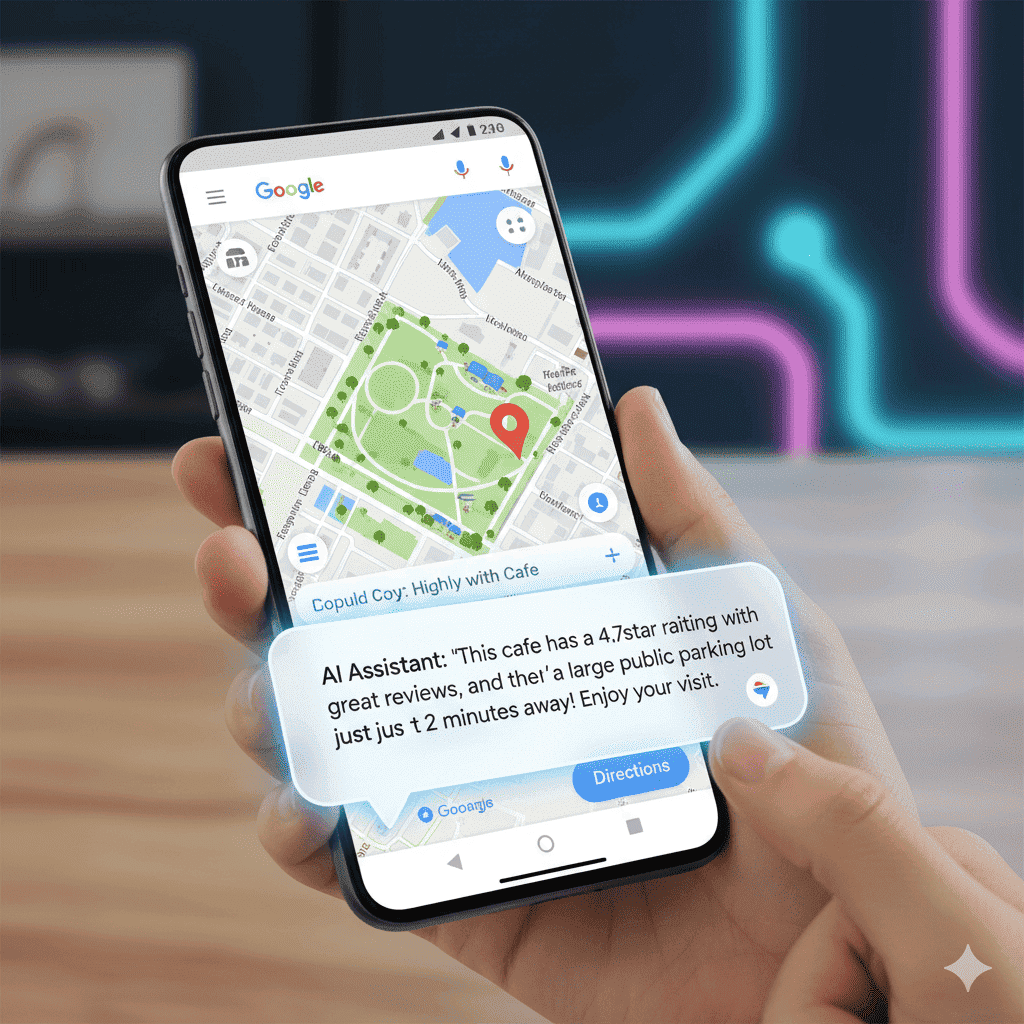
The most noticeable upgrade for everyday users is the infusion of Google Gemini AI into Maps. Previously, Maps was a directional tool; now, it aims to be a collaborative planning partner. This H2 subheading includes the core keyword. 9
The core feature is the ability to handle conversational, complex routing queries that go beyond simple A-to-B navigation.
Real-World Use Cases for Gemini in Maps:
- Complex Planning: Instead of searching multiple times for separate stops, a user can simply ask: “Plan a route from downtown to the art museum, and find a highly-rated coffee shop with outdoor seating near the museum that closes after 8 PM.” Gemini processes this multi-faceted request instantly.
- Real-Time Context: When navigating, if a user asks, “Is the Italian place on the corner open late tonight?” Gemini can cross-reference the map data with business hours, providing the answer without interrupting the primary navigation flow.
This AI-powered capability moves the experience from static search results to dynamic, contextual conversation. This is a crucial step in making the navigation experience truly hands-free and proactive. For a deep dive into the conversational AI features, see our previous article [Internal link to a related Conversational AI article]10. The information is presented clearly using a list. 11

3. Deep Research Upgrade: Accessing Your Personal Data
The second, and perhaps more powerful, update is the enhancement of the Gemini Deep Research tool. This tool is designed to work with Google Workspace, and critically, it now has the authorized ability to pull information from the user’s Gmail, Drive, and Chat files.
This upgrade transforms the research process by unifying external web data with internal, personal documents. The goal is to create comprehensive, context-rich reports instantly.
Deep Research in Action:
Imagine a user needing to prepare a quarterly project summary. The Deep Research tool can now:
- Search the web for “Q4 market trends for cloud computing.”
- Search the user’s Drive for “Project Atlas Q4 status report.”
- Search Gmail for “client feedback Q4 meeting notes.”
- Synthesize all three sources into a unified, drafted report, including cited sources from the user’s own files.
This massive boost in context retrieval means the Google Gemini AI Maps Deep Research combination elevates Gemini from a general-purpose tool to a hyper-personalized professional assistant. Security and privacy remain paramount, with Google emphasizing that users must explicitly authorize access to their private data before the feature works.
4. Competitive Landscape and Future Implications
Google’s strategy is clear: embed AI into the foundational layer of its most-used services to establish an unassailable ecosystem advantage.
While competitors like Microsoft (with Copilot) and Amazon (with its own AI agents) are also integrating AI into their productivity suites, Google’s advantage lies in Maps. No competitor has the same level of real-time, global geospatial data necessary to replicate the conversational navigation provided by Gemini AI in Google Maps.
The integration of Google Gemini AI into both mobility (Maps) and productivity (Workspace Deep Research) points toward a future where the AI knows not just general information, but also your personal context, schedule, and professional history, offering unprecedented levels of assistance.

5. Final Verdict: The Rise of Contextual AI
The recent updates to Google Maps and the Deep Research tool solidify Gemini’s position as a leader in contextual, applied AI. These are not merely flashy features; they are foundational shifts that will save professionals significant time on daily tasks and complex data retrieval.
REALUSESCORE.COM Analysis Scores: Google Gemini AI Integration
| Metric | Score (out of 10.0) | Note |
| Gemini Maps Usability | 9.4 | Transforms navigation from directional to conversational planning; excellent complex query handling. |
| Deep Research Context | 9.8 | Unifying personal (Gmail, Drive) and public data is a massive productivity leap. |
| Ecosystem Strategy | 9.5 | Strategic placement of AI in core Google products guarantees high adoption rates. |
| Privacy and Trust | 8.9 | Requires explicit user authorization, but data access remains a key area of public scrutiny. |
| Market Impact | 9.7 | Sets a high bar for competitor AI models in both mobility and information retrieval. |
| REALUSESCORE.COM FINAL SCORE | 9.5 / 10 | Editor’s Choice – The moment Google AI stopped being a novelty and became the backbone of daily work. |