
1. The Promise of Fusion Energy and the Global Imperative
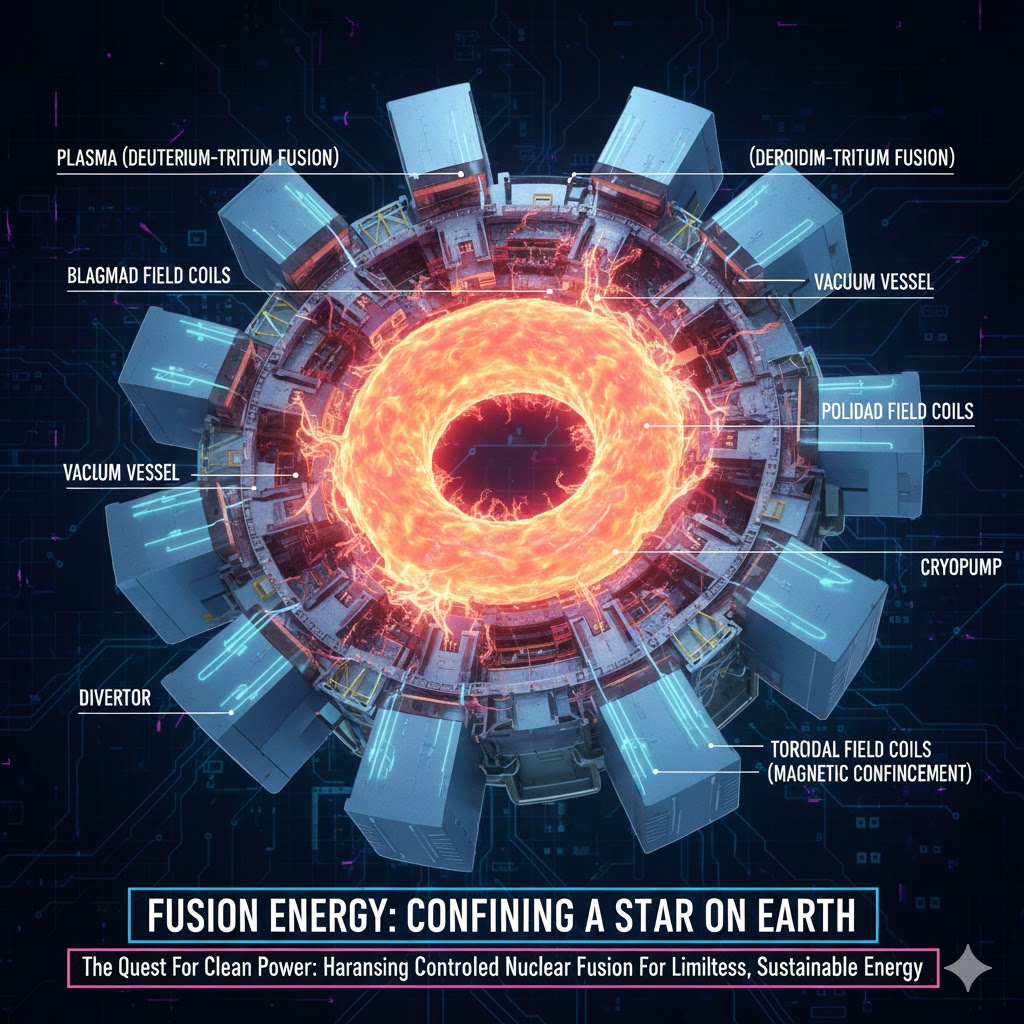
Fusion energy, the process that powers the sun and stars, involves combining light atomic nuclei (typically deuterium and tritium) to release vast amounts of energy.1 If successfully harnessed, it promises a near-limitless, carbon-free, and safe energy source, offering a definitive solution to global climate change and energy security challenges.2
The fundamental scientific feasibility of fusion has been proven; the current global challenge is achieving energy gain (Q>1) in a sustained manner and translating that into a commercially viable power plant. The primary method being pursued globally is magnetic confinement fusion, utilizing a toroidal vacuum chamber known as a Tokamak.3
2. ITER: The Grand International Experiment
The International Thermonuclear Experimental Reactor (ITER) project, based in Cadarache, France, represents the largest scientific collaboration in history, involving 35 nations (including the European Union, China, India, Japan, Korea, Russia, and the United States). Its mission is to prove the technical feasibility of fusion energy.4
A. Key Objectives and Performance Metrics
ITER is designed to achieve two major milestones:
-
Energy Gain (Q >10): It aims to produce 500 MW of fusion power from 50 MW of input heating power (Q=10) for a sustained period of 400 seconds. This would be the first fusion device to achieve sustained, high-power energy multiplication.
-
Sustained Burning Plasma: ITER is intended to demonstrate a self-heating plasma where the energy created by fusion reactions maintains the plasma temperature, minimizing external energy input.
B. Project Status and Milestones
ITER’s construction is a massive undertaking, assembling over one million components. While the project has faced numerous delays and cost overruns, significant progress has been made toward its critical First Plasma milestone.
-
Assembly Progress: The main Tokamak assembly is now in its most intensive phase, involving the integration of multi-ton components like the Vacuum Vessel sectors, cryostat segments, and D-shaped superconducting magnets.5
-
Component Challenges: The complexity of superconducting magnets, the integration of extreme vacuum systems, and the precise welding of massive, high-tolerance components require unprecedented engineering feats.
-
Project Timeline: The current official timeline aims for First Plasma—the initial operation of the machine with hydrogen or helium gas—by approximately 2030, with full Deuterium-Tritium operation scheduled several years later.
3. The Race for Commercialization: Private Sector Disruption
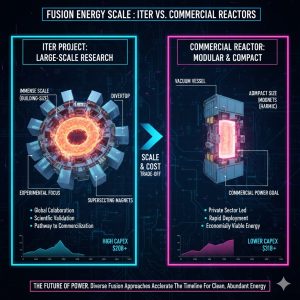
While ITER represents the government-led, large-scale approach to proving scientific viability, the private fusion sector is moving rapidly, fueled by billions in venture capital and focusing directly on developing smaller, more cost-effective, and faster-to-market commercial reactors.6
A. Divergent Technological Approaches
Private companies are exploring alternative and sometimes more innovative paths than the traditional, large-scale Tokamak design:
| Company/Project | Confinement Method | Key Innovation | Commercial Goal Timeline |
| Commonwealth Fusion Systems (CFS) | Tokamak (ARC) | High-Temperature Superconductors (HTS) to create smaller, more powerful magnetic fields. | Early 2030s |
| TAE Technologies | Field-Reversed Configuration (FRC) | Linear approach using advanced confinement to minimize neutron damage and use cleaner fuels. | Mid 2030s |
| Helion Energy | Pulsed Magnetic Compression | Utilizes a pulsed reactor and direct energy conversion, aiming for rapid, modular deployment. | Mid 2020s |
B. The Advantage of Speed and Iteration
Private fusion companies are not bound by the consensus-driven, international complexity of ITER. Their ability to secure rapid funding allows for faster iteration, smaller prototype construction, and a laser focus on the practical engineering and economic challenges of power plant operation (e.g., neutron-resistant materials, tritium breeding).
4. Technical and Regulatory Hurdles for Commercial Fusion
Achieving First Plasma in ITER or demonstrating Q>1 in a private device is only the start. Several significant technical and non-technical challenges remain before fusion power reaches the grid.7
A. Core Technical Obstacles
-
Tritium Self-Sufficiency: Tritium, one of the primary fuels, is scarce.8 Commercial reactors must be able to breed their own tritium within the reactor blanket using lithium, a challenging and necessary technology known as a tritium breeding blanket.9
-
Neutron Damage and Materials: Fusion reactions produce high-energy neutrons that severely damage reactor materials over time.10 Developing materials capable of surviving decades of intense neutron flux is an active area of research.
-
Energy Conversion and Efficiency: The heat generated by fusion must be efficiently and reliably converted into grid-ready electricity, demanding integration with complex power cycle engineering.11 This challenge is similar to optimizing performance in other high-energy fields. For an analysis of optimizing high-performance systems based on resource use, see our comparison on: Serverless Architecture vs. Containerization (Kubernetes): A TCO Analysis for AI Workloads.
B. Regulatory Framework
Unlike fission power, fusion does not produce long-lived radioactive waste, but it requires new, clear regulatory and licensing frameworks.12 Regulators are currently working to classify fusion devices appropriately (often as industrial accelerators rather than nuclear fission reactors) to streamline the path to commercial deployment without compromising safety.13
5. Conclusion: A Decade of Definition
The next decade will be critical. If ITER successfully achieves Q=10, it will validate the scientific principles underpinning the global effort. Simultaneously, the success or failure of private sector prototypes in demonstrating affordable, net-energy-producing fusion will determine the final timeline for grid connection. The convergence of massive government-backed science and agile private sector innovation suggests that fusion power is moving from a distant dream to an achievable reality.
REALUSESCORE Analysis Scores
Analysis of the maturity and challenges in the Fusion Energy sector:
| Evaluation Metric | Scientific Feasibility | Engineering Complexity (ITER) | Private Sector Velocity | Commercialization Risk |
| Current Status | 9.0 | 7.5 | 8.8 | 6.5 |
| Future Outlook (5-10 Yrs) | 9.5 | 8.0 | 9.2 | 8.0 |
| REALUSESCORE FINAL SCORE | 9.5 | 7.8 | 9.0 | 7.5 |