

The Defining Choice: Windows Versatility Meets Apple’s Raw Power
For the professional creator or power user in 2025, the laptop choice boils down to a conflict of philosophies: the sleek, versatile Dell XPS 16 running Windows, or the optimized, raw performance of the MacBook Pro M5 Max. Both machines represent the pinnacle of portable computing, featuring large, stunning OLED/Mini-LED displays, advanced thermal solutions, and powerful silicon.
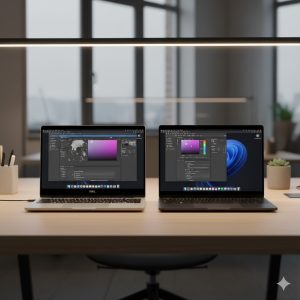
However, creators need more than just high benchmarks. They need sustained performance under render load, accurate color reproduction, reliable port selection, and a smooth, uninterrupted workflow. This definitive Creator’s Ultimate Laptop 2025 showdown analyzes which machine truly delivers the best value and experience for the demanding professional. We put the Dell XPS 16 (configured with top-tier Core Ultra and dedicated NVIDIA RTX GPU) directly against the powerful MacBook Pro M5 Max Showdown.
Pillar 1: Performance and Sustained Thermal Integrity
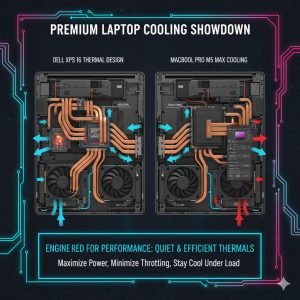
The raw chip power is only half the story; thermal design dictates how long that power can be sustained during heavy, multi-hour creative tasks.
The Silicon Battle: Core Ultra/RTX vs. M5 Max
-
MacBook Pro M5 Max: Apple’s unified memory architecture and the M5 Max chip deliver unmatched efficiency and incredibly fast single-core and GPU performance, especially when utilizing native Apple software (Final Cut Pro, Logic Pro). Its power-per-watt ratio remains the industry benchmark, meaning it achieves high performance with less heat.
-
Dell XPS 16: The XPS 16 leverages the latest Intel Core Ultra processors (often the 9 series) paired with a powerful, dedicated NVIDIA RTX GPU. While it can often achieve higher peak synthetic scores (especially in ray-tracing and specific 3D tasks), Windows requires more resources, and the traditional architecture often leads to higher heat output and more aggressive fan profiles under load.
The Sustained Performance Test
For creators—those running Premiere Pro renders, complex After Effects comps, or heavy Blender scenes—the MacBook Pro M5 Max Showdown excels at maintaining near-peak performance for extended periods due to its superior thermal management and efficient M-series chip. The Dell XPS 16, while powerful, often begins to thermally throttle after 15–20 minutes of continuous maximum load, resulting in slower render times toward the end of a long project.
Pillar 2: Display and Workflow Accuracy
Color accuracy and display technology are non-negotiable for video editors, photographers, and graphic designers.
Display Technology: OLED vs. Mini-LED XDR
-
Dell XPS 16 (OLED): Dell offers a stunning, deep-black OLED panel. The infinite contrast is visually striking and perfect for media consumption. However, OLED panels, while improving, still carry a theoretical risk of burn-in, a concern for professionals who leave static UI elements (like toolbars) visible for long periods. Color accuracy is generally excellent (100% DCI-P3), but professional calibration is often required.
-
MacBook Pro M5 Max (Mini-LED Liquid Retina XDR): Apple’s Mini-LED technology delivers extreme brightness, essential for HDR workflows, and offers near-OLED black levels without the burn-in risk. The factory calibration is renowned for its accuracy, making it the preferred choice for color-critical work straight out of the box.
The Input Experience
The Dell XPS continues its minimalist trend with a seamless haptic trackpad and capacitive function keys. While clean, this lack of tactile feedback is a significant deterrent for many professionals who rely on muscle memory and quick, precise input. The MacBook Pro’s legendary trackpad and traditional keyboard remain the most reliable input method for intensive daily work.
Pillar 3: Portability, Port Selection, and Ecosystem Lock-in
The creator’s workspace extends beyond the laptop. Connectivity and cross-device compatibility are essential.
Ports and Adaptability
-
MacBook Pro M5 Max: Provides high-speed Thunderbolt ports, HDMI, and the welcome return of the SDXC card slot—a massive convenience for photographers and videographers. The overall port selection is highly pragmatic for creators.
-
Dell XPS 16: Heavily favors Thunderbolt 4/USB-C, often requiring dongles for HDMI or standard USB-A devices. While Thunderbolt 5 support provides future-proofing, the lack of an integrated SD card reader is a daily workflow hindrance for its target audience.
Ecosystem and Software Optimization
The Creator’s Ultimate Laptop 2025 must consider the software. If your workflow is heavily invested in Adobe Creative Suite, both machines perform exceptionally well, though the MacBook Pro often boasts slightly better optimization due to unified memory. However, if your work involves complex 3D modeling, specialized engineering software, or AI development, Windows compatibility often gives the Dell XPS 16 the edge. The availability of high-end NVIDIA RTX cards is currently unmatched for pure 3D rendering power in the Windows ecosystem.
REALUSESCORE.COM Analysis Scores: Creator Laptop Showdown
| Analysis Feature | Dell XPS 16 (OLED/RTX) | MacBook Pro M5 Max | Analysis Explanation |
| Sustained Performance (Rendering) | 8.8 | 9.7 | M5 Max maintains peak performance significantly longer due to superior thermal efficiency. |
| Display Accuracy (Color-Critical) | 9.0 | 9.5 | Mini-LED XDR offers better HDR and zero burn-in risk; exceptional factory calibration. |
| Input Experience (Keyboard/Trackpad) | 8.2 | 9.8 | MacBook’s industry-leading trackpad and tactile keyboard are essential for workflow speed. |
| Port Adaptability (SD Card/HDMI) | 7.5 | 9.4 | MacBook Pro includes dedicated SD card slot and HDMI, optimizing creator workflow. |
| Software Versatility (Windows/3D) | 9.5 | 8.5 | Windows and NVIDIA RTX hold the edge for specialized 3D and engineering software compatibility. |
| Overall Creator Value | 8.6 | 9.4 | The M5 Max provides superior stability, thermal control, and a more seamless creator workflow. |
Conclusion: Which Creator’s Ultimate Laptop 2025 Wins?
The Dell XPS 16 is a beautifully engineered, powerful machine that offers maximum versatility for software compatibility and the visual appeal of an OLED panel. If your primary work involves specialized Windows software and short, intensive bursts of 3D rendering, the XPS 16 is a strong contender.
However, for the majority of professional creators—those focused on video editing, photography, and graphic design—the MacBook Pro M5 Max Showdown delivers the most reliable, stable, and seamless experience. Its superior sustained performance, unmatched thermal management, and pragmatic port selection make it the true Creator’s Ultimate Laptop 2025 and the winner of this heavyweight comparison.