
The landscape of software development is being rapidly redefined by intelligence, not just automation. AI-Powered Code Generation tools are no longer futuristic concepts; they are seamlessly integrated into modern Integrated Development Environments (IDEs), fundamentally shifting the way developers write, debug, and maintain software. The profound impact of How LLMs are changing the developer IDE workflow affects everyone from junior coders to senior architects. This article analyzes the core mechanisms, benefits, and challenges of this transformation, proving that AI-Powered Code Generation is setting the developer IDE workflow standard for 2025.
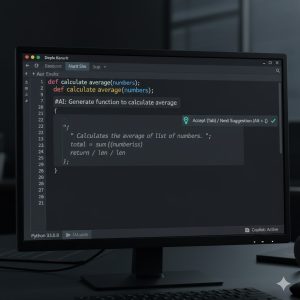
1. The Core Shift: How LLMs are changing the developer IDE workflow
The primary transformation lies in moving from static autocomplete features to dynamic, context-aware code suggestions. Large Language Models (LLMs) analyze millions of lines of open-source code and proprietary repositories to understand not just syntax, but intent.
Contextual Understanding and Productivity
The best AI-Powered Code Generation tools understand the full context of a project—the files, class names, function signatures, and comments—to generate far more accurate and complex blocks of code than ever before. This significantly impacts productivity.
- Full Function Generation: Instead of simple line completion, LLMs can generate entire functions based on a simple comment prompt (e.g., “function to validate user email format”).
- Multi-Language Support: The utility of AI-Powered Code Generation spans languages, from Python to Rust, reinforcing How LLMs are changing the developer IDE workflow across the stack.
2. Deep Integration: AI in the Developer IDE Workflow
The integration of these tools into the IDE (e.g., VS Code, IntelliJ) is key to adoption. It minimizes context switching, keeping the developer focused on the problem rather than the syntax.
Beyond Code: Testing and Documentation
AI-Powered Code Generation extends its utility beyond just writing new code:
- Automated Unit Testing: LLMs can analyze a new function and automatically generate corresponding unit tests, ensuring code quality and test coverage. This is a critical component of the modern developer IDE workflow.
- Documentation Drafting: Based on the generated code and comments, AI can draft preliminary documentation and API descriptions, saving developers hours of mundane work. For more on maximizing efficiency, check out our guide on Advanced DevOps Automation 2025.

3. Challenges to AI-Powered Code Generation Adoption
While the benefits are transformative, AI-Powered Code Generation presents significant challenges that affect both security and governance.
| Challenge | Impact on Developer IDE Workflow | Mitigation Strategy |
| Code Security & Licensing | LLMs may inadvertently generate code snippets derived from GPL or vulnerable open-source code. | Robust filtering layers and mandatory license checking on generated output. |
| Skill Erosion | Over-reliance on AI-Powered Code Generation may reduce junior developers’ understanding of core logic. | Mandatory code reviews focusing on generated code logic, not just function. |
| Context Overload | Tools struggle with vast legacy codebases, generating inaccurate code due to context limits. | Continuous optimization of context window and project indexing capabilities. |
These challenges must be addressed for How LLMs are changing the developer IDE workflow to succeed in enterprise environments.
Final Verdict: The Future of the Developer IDE Workflow
The AI-Powered Code Generation revolution is here to stay. It is the defining technology that determines How LLMs are changing the developer IDE workflow—by shifting the developer’s role from a typist to an editor and architect. The massive productivity gains, particularly in generating boilerplate code, make this an essential upgrade for any modern development team. By embracing AI-Powered Code Generation, organizations ensure they are prepared for the future of software development. Explore the latest AI coding tools and best practices on the official OpenAI Developer Blog.