
1. Introduction: The Generative AI Reckoning
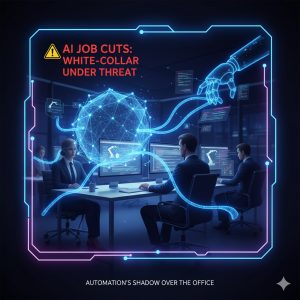
For decades, automation fears centered around blue-collar roles. Today, the anxiety has shifted sharply to the office. Generative AI tools like ChatGPT and Gemini are demonstrating capabilities that directly overlap with core white-collar tasks: drafting emails, writing code, summarizing documents, and performing basic legal research.
The reality is stark: major companies are already reporting increased productivity from AI, leading to strategic layoffs. This trend is sparking an Anxiety Epidemic among knowledge workers. This deep-dive post analyzes the primary drivers behind recent AI Job Cuts, identifies the roles most at risk, and, most importantly, provides actionable White-Collar Protection strategies to secure your professional future against the wave of automation.
2. Analyzing the Drivers of Recent AI Job Cuts
The current wave of layoffs, often euphemistically called “optimization,” is not about replacing every human worker. It’s about automating the repetitive and highly measurable tasks that fill a significant portion of a white-collar workday.
A. The Automation of the “In-Between” Tasks
AI excels at the interstitial work that makes up 60-80% of many roles:
- Junior Roles: Entry-level analysts, paralegals, and junior coders whose primary tasks are data collection and drafting initial content are highly exposed.
- High-Volume Content: Marketing copywriting, social media content generation, and technical documentation are being streamlined, eliminating the need for large teams.
B. Increased Efficiency, Reduced Headcount
A recent survey showed that professionals using Generative AI reported up to a 40% increase in work speed for certain tasks. This translates directly to the need for smaller teams. A company can now achieve the same output with 3 employees leveraging AI as it previously did with 5, leading to strategic AI Job Cuts in roles deemed redundant.
3. The Roles Most Exposed to AI Automation
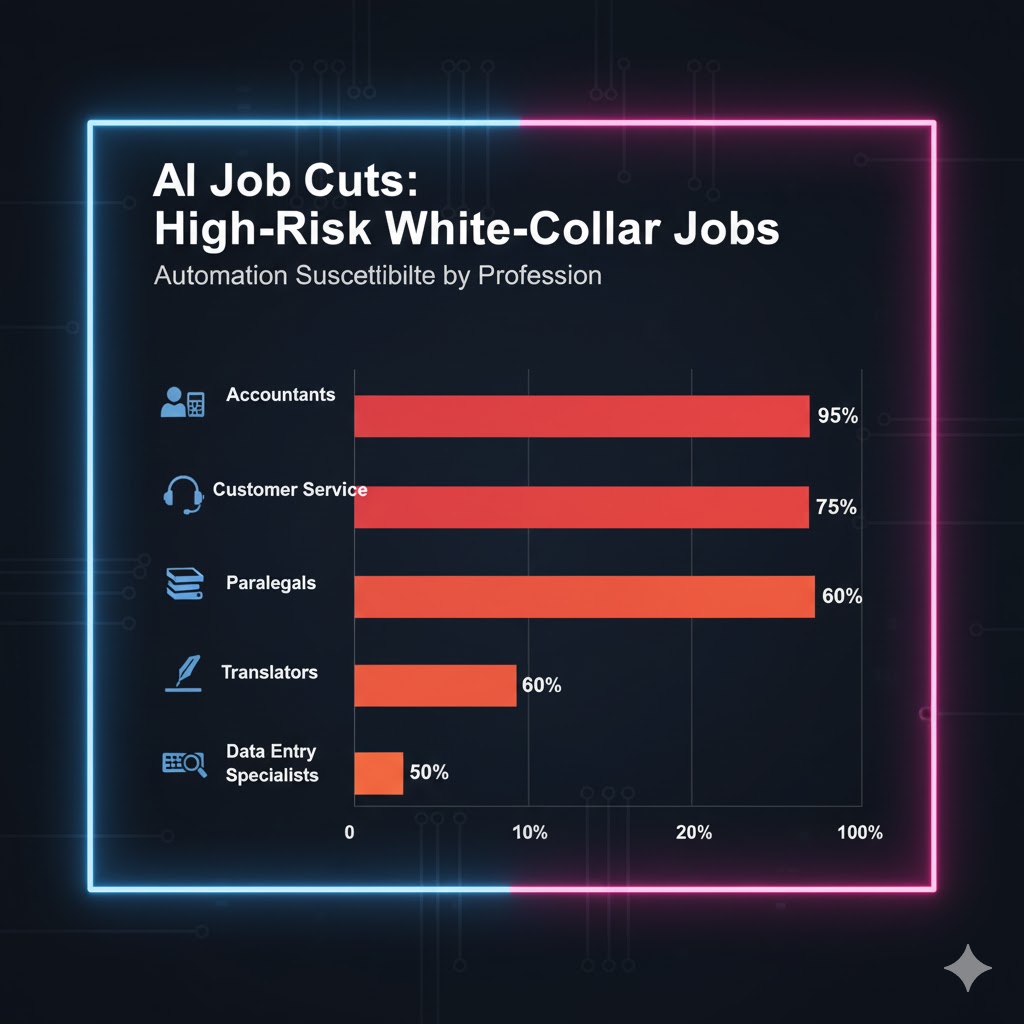
While no job is entirely safe, some roles have a higher exposure index due to their reliance on digitized data and predictable processes.
| High-Risk White-Collar Roles | Why They Are At Risk | White-Collar Protection Strategy |
| Data Entry/Processing Clerks | Highly repetitive and template-driven tasks. | Transition to Data Verification and AI Prompt Engineering. |
| Copywriters/Content Writers | AI can generate high volumes of draft content instantly. | Focus on Strategic Narrative, Voice/Tone Oversight, and Emotional Resonance. |
| Entry-Level Programming | Simple code generation and debugging tasks. | Shift to System Architecture, Ethical AI Deployment, and Complex Problem Solving. |
| Paralegals/Researchers | AI is highly effective at summarizing legal documents and precedents. | Develop expertise in AI Legal Compliance and Cross-Disciplinary Consulting. |
4. White-Collar Protection Strategies: Future-Proofing Your Career
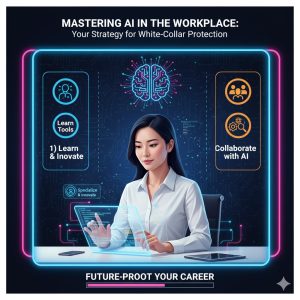
The future of work is not about competing against AI; it’s about competing with people who master AI. Here are three critical strategies for achieving White-Collar Protection:
A. Master the AI Tools (Prompt Engineering)
The ability to elicit high-quality, precise, and complex outputs from Generative AI (i.e., Prompt Engineering) is the single most valuable skill. Learn how to integrate tools like Copilot, Gemini, and Claude directly into your workflow to increase your value to your employer. Your job becomes managing the AI, not performing the task it handles.
B. Embrace ‘Un-Automatable’ Skills (The 4 Cs)
AI struggles with tasks requiring truly human elements. Prioritize developing the following four skills:
- Creativity: Generating novel ideas and artistic direction.
- Critical Thinking: Evaluating, challenging, and synthesizing complex information that the AI only collects.
- Communication (High-Stakes): Leading negotiations, delivering motivational speeches, and handling sensitive client relationships.
- Context: Understanding unwritten company culture, political dynamics, and nuanced industry foresight.
C. Shift Focus from Process to Outcome
The new mandate for white-collar workers is to move from ‘executing a process’ to ‘delivering a high-value outcome’. If your current job description is a list of tasks, reframe it to be a list of strategic results you achieved using AI, making you indispensable.
5. Final Verdict: The Need for Urgent Adaptability
The threat of AI Job Cuts is real, but it is less a threat of total replacement and more a threat of rapid upskilling and adaptation. The window of opportunity for White-Collar Protection is closing rapidly.
Professionals who view AI as a powerful, mandatory co-pilot, and who actively develop the uniquely human skills of critical thought and high-level strategy, will not only survive but thrive in the automated economy. Adaptability is no longer a soft skill—it is job security.