
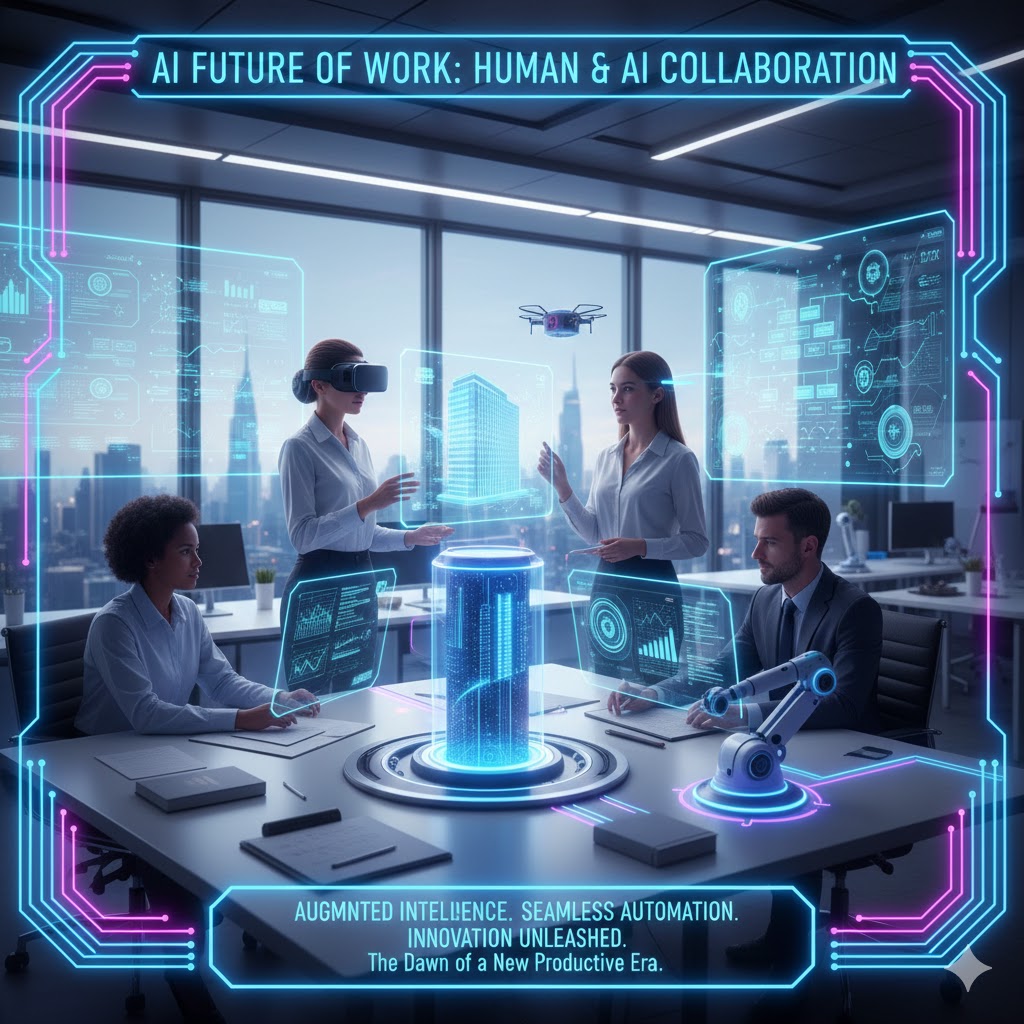
1. Introduction: The Generational Shift in the Global Labor Market
The integration of Artificial Intelligence (AI) into the professional ecosystem is not merely an incremental technology update; it represents a generational shift in how value is created and labor is compensated. As AI models become less abstract and more capable of performing complex, cognitive tasks—from generating code to drafting legal documents—the definition of “work” is being fundamentally rewritten. The fear of mass job displacement, though prevalent, often overshadows a more nuanced reality: AI is less about replacement and more about profound job transformation.
This comprehensive guide delves into the mechanisms of AI-driven automation, analyzes the emergence of new “digital labor” roles, and outlines the critical strategies required for both individuals and organizations to navigate the reskilling imperative. Our analysis focuses on actionable insights and near-future trends (2026 and beyond) that will define career stability and economic growth in the AI-centric world.

2. Phase 1: The New Wave of Automation (Cognitive vs. Physical Labor)
The history of automation has traditionally focused on replacing routine physical tasks (blue-collar labor). AI, particularly Generative AI (GenAI), now targets the high-value, non-routine cognitive functions (white-collar labor), marking a distinct shift in automation’s reach.
2.1. The Automation of Cognitive Tasks
GenAI, powered by large language models (LLMs) and multimodal networks, excels at pattern recognition, synthesis, and creative generation. Its primary impact is not eliminating entire job titles, but eliminating tasks within those jobs.
-
Law and Finance: Tasks such as contract drafting, preliminary legal research, and market data analysis are becoming highly automated. The human role shifts from performing data collection to validating AI outputs and focusing on high-level strategy and client interaction.
-
Software Development: AI tools now generate baseline code, debug errors, and handle testing frameworks. The engineer’s value moves from syntax writing to system architecture and integrating complex AI APIs, fundamentally changing the definition of “coding.”
-
Creative Industries: Marketing copy, graphic templates, and basic video scripts can be generated in seconds. Creative professionals must now master prompt engineering and become supervisors of AI-generated content, focusing their time on conceptualization and brand narrative integrity.
2.2. The Automation of Physical Tasks (The Next Frontier)
While GenAI dominates the discussion, advancements in robotics and computer vision continue to automate physical labor, often guided by AI.
-
Logistics and Warehousing: Advanced vision systems guide autonomous mobile robots (AMRs) for complex sorting and retrieval.
-
Manufacturing: AI-driven predictive maintenance and quality assurance systems monitor production lines with sub-millimeter precision, drastically reducing human inspection labor and factory downtime. The future blue-collar worker becomes a technician specializing in robot fleet maintenance and data interpretation.
3. Phase 2: The Rise of Digital Labor and New AI-Driven Roles
Automation does not simply delete labor; it reallocates it. The vacuum left by automated tasks is being filled by entirely new categories of work centered around the AI ecosystem.
3.1. The Digital Labor Market: Data and Refinement
A significant portion of new work involves interacting directly with AI systems, often referred to as “Digital Labor” or “Human-in-the-Loop” work:
-
Prompt Engineers: These specialists are vital for extracting high-quality, reliable output from GenAI models. Their job is not programming, but crafting complex, iterative instructions (prompts) to guide the AI toward specific, business-relevant outcomes. This role sits at the intersection of creativity, domain expertise, and linguistic precision.
-
Data Curators and Annotators: AI models are only as good as the data they are trained on. Millions of hours of human labor are dedicated to cleaning, labeling, and validating massive datasets to prevent bias, ensure accuracy, and define ethical boundaries for the AI. This foundational work forms the invisible infrastructure of the AI economy.
-
AI Explainability (XAI) Specialists: As AI systems become complex “black boxes,” these specialists are needed to audit and interpret AI decisions for regulatory compliance, ethical review, and error mitigation. This role demands a unique combination of statistical knowledge and strong communication skills.
3.2. Economic Impact: The Unbundling of Roles
AI acts as a force of “unbundling,” breaking down monolithic jobs into smaller, automated tasks and higher-level human oversight functions. This results in the creation of many new micro-jobs and specialized consulting roles focused entirely on AI integration and optimization, contributing to a more modular and freelance-heavy gig economy.
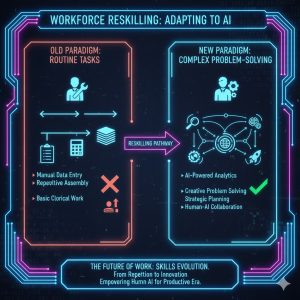
4. Phase 3: The Reskilling Imperative for Longevity
For individuals and organizations, simply accepting the change is not enough. Proactive, structured reskilling and upskilling are the only reliable pathways to career longevity in the AI era.
4.1. Individual Reskilling Strategies
The focus must shift from acquiring technical knowledge of specific software to developing AI-proof meta-skills:
-
Critical Evaluation and Synthesis: The ability to discern high-quality, accurate information from low-quality AI-generated noise is paramount. This includes fact-checking, bias detection, and cross-referencing AI outputs.
-
Complex Problem-Solving and Strategic Thinking: AI can solve routine problems efficiently, but humans must define the novel problems, set the strategic goalposts, and handle situations involving high emotional intelligence or ethical ambiguity.
-
Adaptability and Learning Agility: As the pace of technological change accelerates (measured by the rapid iteration of LLM generations), the capacity to quickly adopt new tools and learning paradigms will be the most valuable asset.
4.2. Corporate and Governmental Responsibility
The burden of reskilling cannot fall solely on the individual. Corporations and governments must implement large-scale educational programs:
-
Corporate L&D Transformation: Companies must move away from generic training toward AI-centric learning and development (L&D) pathways. This includes mandatory courses on ethical AI usage, specialized prompt engineering certifications for every department, and internal mentorship programs pairing domain experts with data scientists.
-
Governmental Policy: Public education systems must integrate data literacy and computational thinking from an early age. Furthermore, governments should invest in subsidized sector-specific reskilling vouchers targeted at industries most vulnerable to automation (e.g., call centers, data entry).
5. Phase 4: Economic Policy and The AI Productivity Paradox
The widespread deployment of AI raises profound questions about global economic structures, labor compensation, and welfare policy.
5.1. The Productivity Paradox and Economic Metrics
Historically, new technologies often lead to a “productivity paradox,” where investment rises but productivity growth stalls temporarily (as seen in the early days of IT adoption). This is because the workforce and business processes take time to fully integrate and leverage the new tools. In the short term, AI investment will continue to rise dramatically (driven by compute infrastructure spending), but true, measurable GDP growth may lag until businesses fully re-engineer their workflows around GenAI. Economists predict this lag will shrink due to the rapid rate of AI model deployment.
5.2. The Debate on Universal Basic Income (UBI)
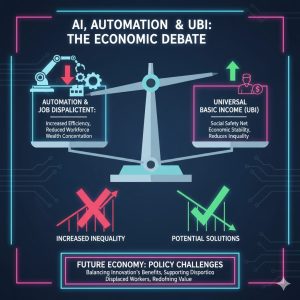
As automation accelerates, the discussion around welfare safety nets, particularly Universal Basic Income (UBI), gains urgency. Proponents argue that UBI provides a necessary social floor, stabilizing consumer demand even as automation reduces the number of full-time, traditional jobs. Critics, however, warn that UBI could disincentivize necessary reskilling and create structural labor shortages in essential sectors that AI cannot fully replace (e.g., healthcare, infrastructure maintenance). A more likely near-term solution is Universal Basic Services (UBS), providing key necessities like education and healthcare directly.
5.3. Global Regulatory Convergence
International bodies (EU, US, OECD) are racing to regulate AI, focusing heavily on transparency and accountability. Future labor policies will be tied to these regulations, potentially mandating that companies clearly disclose when AI is being used in hiring, performance reviews, and termination decisions, ensuring fairness and preventing algorithmic bias from exacerbating social inequalities.
6. Conclusion: Navigating the Transformation
The AI revolution is defined by the automation of routine, predictable tasks and the simultaneous creation of new roles focused on high-level strategy, human empathy, and creative direction. The future of work is not a binary choice between human and machine, but a symbiotic partnership.
Success in the 2026 job market requires individuals to embrace a mindset of continuous learning, prioritizing meta-skills over static technical certifications. For businesses, the challenge is not just implementing AI tools, but completely redefining organizational roles and committing to large-scale, ethical reskilling programs. Those who proactively manage this transformation, rather than passively react to it, will secure the highest returns—both economically and professionally—in the future of work.