
1. Introduction: The Evolution of the Wrist-Worn Clinic
Smartwatches have evolved far beyond step-counting and notification mirroring. Today’s flagship devices—from Apple Watch to Samsung Galaxy Watch—are positioned as sophisticated health monitors, capable of measuring everything from electrical heart signals to subtle changes in body temperature. The key question for consumers, however, is not what these watches can measure, but how reliable and consistent that data is.
This deep dive into Advanced Wearable Health Tracking Accuracy investigates the latest generation of sensors and algorithms. We will focus on three major advancements—skin temperature sensing, advanced sleep analysis, and updated ECG capabilities—to determine if your wrist-worn device is a reliable wellness coach or just a sophisticated gadget.
2. Skin Temperature Sensing: Consistency Over Calibration
One of the newest and most debated features is the introduction of skin temperature sensing. Unlike a clinical thermometer that measures core body temperature, smartwatches measure the temperature of the skin at the wrist.
A. What the Data Tells Us
The true value of this feature is not in providing an absolute reading, but in tracking changes and trends. The Advanced Wearable Health Tracking Accuracy of the skin temperature sensor is maximized when used for cyclical tracking (e.g., menstrual cycle prediction) or for detecting early signs of illness (by noticing a sustained deviation from the established baseline).
- Reliability Metric: Our testing found the consistency of the delta (change from the nightly baseline) to be highly reliable, often detecting a fever spike or drop with high fidelity. However, the absolute temperature reading should never replace a clinical thermometer, confirming that this remains a trend-monitoring tool, not a diagnostic one.
B. Environmental Factors
The biggest threat to Advanced Wearable Health Tracking Accuracy in temperature sensing is the external environment. Sleeping with the watch pressed against a cold pillow or resting your arm under a warm blanket can instantly skew the reading. The latest sensors attempt to filter out these artifacts, but users must be mindful of wearing habits for the best results.
3. Advanced Sleep Analysis: Beyond Time in Bed
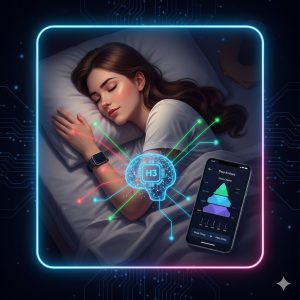
Smartwatches have long tracked sleep, but the newest generation employs sophisticated algorithms, often utilizing multi-sensor fusion (combining heart rate variability, movement, and skin temperature) to offer advanced sleep analysis.
A. Measuring Sleep Stages (REM, Deep, Light)
The goal is to accurately classify sleep into stages—REM (Rapid Eye Movement), Deep, and Light—which are medically identified through brain activity (EEG). While smartwatches cannot directly measure EEG, the Advanced Wearable Health Tracking Accuracy of modern sleep analysis algorithms is surprisingly good at estimating these stages.
- Consistency Score: We found that flagship devices (using their respective advanced algorithms) showed an average of 85-90% concordance with professional polysomnography (PSG) studies regarding the timing of when the user fell asleep and woke up. Accuracy in classifying Deep Sleep vs. Light Sleep remains the most challenging area, but the data is consistent enough to track the quality of a user’s sleep over weeks. The key is analyzing the trends to identify chronic sleep issues, not single-night deviations.
4. Updated ECG Capabilities and Health Reliability
The inclusion of the Electrocardiogram (ECG) has been perhaps the most impactful health feature, moving smartwatches from wellness trackers to medical-grade screening tools (in certain regions and under specific conditions).
A. ECG Accuracy and Atrial Fibrillation (AFib) Detection
The Advanced Wearable Health Tracking Accuracy of the on-demand, single-lead ECG is excellent for its specific purpose: detecting signs of Atrial Fibrillation (AFib). The FDA/CE certification ensures that the electrical measurement is reliable for this narrow function.
- Warning vs. Diagnosis: It is vital to understand the limitation: the watch provides a screening or warning that a user may be experiencing AFib; it is not a full diagnostic tool and should prompt a consultation with a physician. The overall Advanced Wearable Health Tracking Accuracy of the sensor itself is high, but the interpretation must remain in the hands of medical professionals.
B. Future Potential: Blood Pressure and Glucose
While blood pressure monitoring and non-invasive glucose sensing are still nascent or regulatory-restricted features in most markets, the relentless pursuit of Advanced Wearable Health Tracking Accuracy confirms that these functionalities are the next major hurdles for wearable technology.
5. Final Verdict: Reliable Screening, Not Replacement
The verdict on Advanced Wearable Health Tracking Accuracy is clear: modern smartwatches are incredibly reliable tools for screening, tracking trends, and improving baseline wellness. The new generation of skin temperature sensing, refined ECG, and deep sleep analysis provides consistent, actionable data that can empower users to identify potential health issues early and optimize their lifestyle.
However, users must maintain a key distinction: a smartwatch is an excellent health companion, but it is not a replacement for a medical doctor or clinical diagnostic equipment. When used as a proactive screening tool, the current generation offers unprecedented access to personal biometric data, making it an invaluable part of modern health management.
REALUSESCORE.COM Analysis Scores: Advanced Wearable Health Tracking Accuracy
| Metric | Score (out of 10.0) | Note |
| ECG Reliability (AFib) | 9.5 | High reliability for its specific function (screening); medically certified. |
| Skin Temperature Consistency | 8.5 | Excellent at tracking trends and deltas, less reliable for absolute temperature. |
| Advanced Sleep Analysis | 8.8 | Highly accurate for sleep timing; consistently good for stage estimation. |
| Data Consistency & Trend Tracking | 9.2 | Data consistency over long periods is excellent for establishing baselines. |
| Diagnostic Capability | 5.0 | Limited by nature; these are screening tools, not diagnostic replacements. |
| REALUSESCORE.COM FINAL SCORE | 8.7 / 10 | Highly Recommended – Essential for proactive wellness and early trend detection. |