
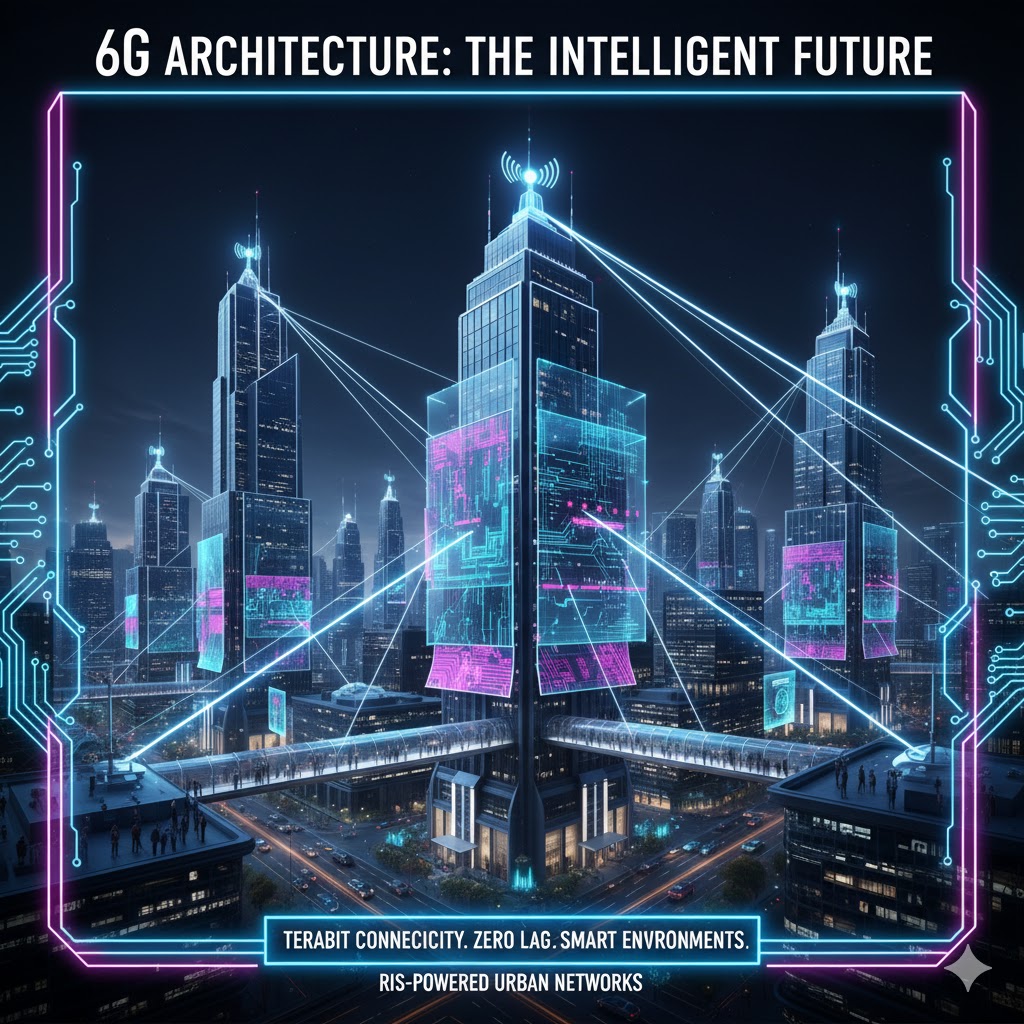
The Next Communications Revolution: Beyond the Limits of 5G
In 2025, while 5G networks are becoming mainstream, major telecommunications companies and tech giants worldwide are already hyper-focused on the development of 6G Communication Technologies. 6G is not merely about incremental speed upgrades; it represents a fundamental paradigm shift in wireless communication. It targets speeds 100 times faster than 5G and latency reduced to 1/10th, enabling future technologies like seamless holographic communication, hyper-realistic Extended Reality (XR), and true Digital Twins.
For technical professionals, engineers, and strategists (35-55) preparing for the future of industry, understanding the core technology and the development roadmap of 6G is essential. This in-depth analysis breaks down the technical foundations, the industry-wide Expected Benefits and Timeline, and predicts the dawn of the Next-Generation Wireless era.

Pillar 1: The Technical Foundation—Terahertz and Intelligent Surfaces
The most crucial technologies 6G adopts to break through 5G limitations involve utilizing ultra-high frequency bands and creating an “Intelligent Environment.”
The Terahertz (THz) Frequency Band
Where 5G utilizes millimeter-wave (mmWave), 6G leverages the Terahertz (0.1 THz to 10 THz) band. This band offers an immense spectrum, theoretically enabling speeds reaching 1 Tbps per second.
-
Advantage: This is the core driver for achieving ultra-high speed and ultra-low latency, allowing for the real-time transmission of massive data volumes (8K video, holographic data).
-
Challenge: Terahertz waves have extremely high directionality, very poor penetration through obstacles, and short transmission distances. This necessitates entirely new antenna and environment control technologies.
Reconfigurable Intelligent Surfaces (RIS)
To overcome the poor penetration of Terahertz waves, RIS technology is introduced. RIS are panels attached to building walls or surfaces that can actively reflect or refract incoming radio signals, directing them even into dead zones that signals struggle to reach. This makes the wireless communication environment itself programmable, completing the Next-Generation Wireless ecosystem.
Pillar 2: 6G Expected Benefits and Timeline
6G is expected to deliver transformative benefits across industries and personal lives, going far beyond just increasing smartphone speed.
1. Enabling Immersive XR and Holographic Communication
In 5G environments, immersive XR (VR/AR/MR) often causes motion sickness or lag. 6G’s latency target of below 0.1ms is below the human perception threshold. This means the time delay between interaction in the virtual world and the physical world becomes imperceptible, enabling real-time control within true Digital Twin environments and flawless holographic communication.
2. AI-Native Network Convergence
The 6G network itself is being designed as AI-native. AI will analyze traffic load, device location, and user patterns in real-time to autonomously optimize network resources.
-
Benefit: This maximizes operational efficiency by having the network predict traffic, automatically reroute itself before failures occur, and dynamically allocate resources, leading to significant cost savings for operators.
3. Enhanced Sensing and Positioning Capabilities
6G inherently incorporates Sensing functionality in addition to communication. By utilizing radio signals to sense movement, distance, and even the material of surrounding objects, the communication network effectively acts as a high-resolution radar system. This will vastly improve the precise environmental awareness of autonomous vehicles and the control accuracy of robots in smart factories.

Pillar 3: Commercialization Timeline and Challenges
Just as important as the technology’s potential are its actual deployment schedule and the obstacles it faces.
Projected Commercialization Timeline (Based on 2025)
| Phase | Estimated Timeframe | Key Activities and Goals |
| Research & Initial Standardization | 2025 ~ 2027 | Terahertz band research, Proof-of-Concept for key technologies like RIS, commencement of frequency allocation discussions via ITU. |
| Standard Finalization & Trials | 2028 ~ 2030 | Finalization of 6G international standard (Release), setup of trial networks by major carriers, completion of Next-Generation Wireless core equipment development. |
| Commercial Service Launch | Post-2030 | Large-scale commercial service begins, deployment of 6G-enabled devices and market expansion. |
Technical and Economic Challenges
-
New Chip and Antenna Development: Highly efficient, low-power chips and antennas supporting the Terahertz band must be miniaturized to fit into smartphone dimensions.
-
International Frequency Coordination: Global consensus and allocation of 6G’s core frequency bands are essential, a process that requires significant international diplomatic cooperation.
-
Massive Infrastructure Investment: The deployment of large-scale infrastructure like RIS across entire cities will require immense initial capital investment.

REALUSESCORE.COM Analysis Scores: Next-Generation Wireless
| Analysis Feature | 5G (Current) | 6G (Expected) | Analysis Explanation |
| Peak Speed (Gbps) | 20 | 1,000 | Expected speed increase of over 50x due to the use of the Terahertz band. |
| Latency (ms) | 1 ~ 10 | 0.1 and below | The critical target for true holographic communication and real-time autonomous system control. |
| AI Integration Level | Partial Optimization | AI-Native (Autonomous Network) | Network operations are autonomously managed by AI, maximizing efficiency. |
| Sensing and Location Accuracy | Limited | Integrated Sensing Function | The network acts as a radar, enabling precise environmental awareness. |
| Expected Benefits and Timeline (Commercialization) | N/A | Post-2030 | Realistic timeline reflecting the difficulty of standardization and core chip development. |
| Overall Next-Generation Wireless Value | 7.0 | 9.5 | 6G has the potential to fundamentally change industrial infrastructure, not just communication. |
Conclusion: The Era of True Hyper-Connectivity
6G Communication Technologies are set to overcome the limitations of 5G, realizing ultra-low latency of 0.1ms and ultra-high-speed communication up to 1 Tbps. This infrastructure is vital for establishing holographic communication, perfect Digital Twins, and AI-driven autonomous networks.
While challenges remain in miniaturizing Terahertz technology and achieving international standardization, based on the roadmaps of major corporations, the revolutionary Expected Benefits and Timeline of 6G are projected to materialize around 2030. The competitiveness of future industries will largely depend on how quickly they embrace this communication revolution.