
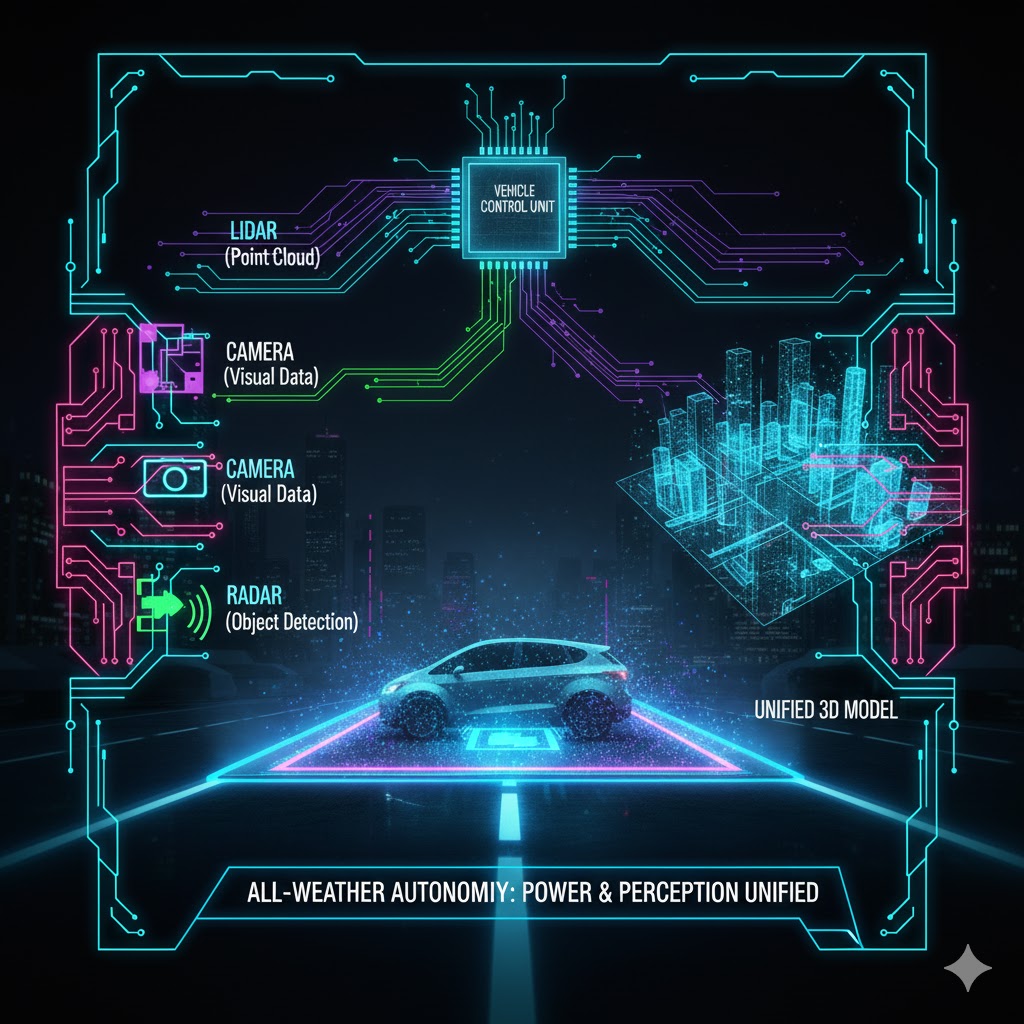
1. Introduction: The Two Pillars of Autonomy
Autonomous Vehicles (AVs) represent the fusion of electrical engineering and artificial intelligence. However, the path to Level 4 autonomy is fundamentally driven by two interdependent technological revolutions: the ability to power the vehicle reliably and the ability to see the world accurately.
The systems powering self-driving—the high-resolution sensors, powerful GPUs, and redundant safety computers—are energy hogs. Therefore, the Autonomous Vehicle Batteries must evolve. Simultaneously, the sensors must become sharper, cheaper, and more resilient to adverse conditions, making Lidar and Sensor Fusion central to perception. This dual evolution defines the current progress of the AV industry.

2. Powering Perception: The Autonomous Vehicle Batteries Revolution
The current generation of lithium-ion batteries struggles to meet the sustained energy demands of Level 4 (L4) autonomous systems while maintaining consumer-acceptable range and charging times. The solution lies in next-generation chemistry, primarily Solid-State Batteries (SSBs).
A. Solid-State Breakthroughs (Post-2024)
- Higher Energy Density: SSBs replace the volatile liquid electrolyte with a solid one, allowing the use of lithium-metal anodes. This fundamentally increases gravimetric energy density, pushing capabilities beyond 450 Wh/kg. For an AV, this means a potential 25% range increase for the same battery weight and size.
- Enhanced Safety: The solid electrolyte is non-flammable, virtually eliminating the thermal runaway and fire risk associated with liquid Li-ion. This enhanced safety simplifies thermal management, further reducing battery pack weight and complexity.
- Ultra-Fast Charging: Innovations have demonstrated charging from 15% to 90% in as little as 18 minutes, tackling a major consumer barrier to mass EV adoption.
B. The Power-Autonomy Interdependence
A high-energy-density battery is essential because L4 and L5 systems consume significantly more power. Powerful Lidar, always-on radar, and the computational load of raw Lidar and Sensor Fusion constantly drain the battery, making the switch to SSBs an enabler for truly effective, long-range autonomous driving.
3. Sensing the Future: The Lidar and Sensor Fusion Evolution
For an AV to operate safely, its sensor suite (eyes) must exceed human perception, especially under challenging conditions like heavy rain, fog, or night driving. The industry is moving beyond simply adding more sensors to achieving smarter Sensor Fusion.
A. The Lidar Leap
Lidar (Light Detection and Ranging) remains the gold standard for high-resolution 3D mapping. The evolution has focused on two key areas:
- Cost and Size Reduction: The shift from spinning mechanical Lidar to solid-state Lidar using MEMS micromirrors has dramatically reduced sensor size and manufacturing cost, making it viable for mass-market vehicles.
- Power and Range: New components, such as advanced edge-emitting lasers, significantly increase the Lidar range while reducing the electrical current draw. This improved energy efficiency is critical for balancing the demands on Autonomous Vehicle Batteries.
B. The Rise of New Modalities and Fusion
The limitations of Lidar (vulnerability to heavy rain/snow) and cameras (poor night performance) mandate a robust system based on Sensor Fusion:
- Raw Data Fusion: The industry consensus is shifting from “object-level fusion” (where each sensor identifies objects independently) to “raw data fusion” (combining the uninterpreted data streams). This provides the perception system with richer, less ambiguous data for real-time decision-making.
- Terahertz (THz) Vision: Emerging technologies, such as the Terahertz vision sensor, promise a new, “all-weather” category of sensing. THz vision offers up to 20x better resolution than conventional radar while maintaining performance in adverse weather, posing a future challenge to Lidar and fully enabling L4 systems regardless of climate.

4. Conclusion: The Interdependent Race to L4
The progress in Autonomous Vehicle Batteries and the advancements in Lidar and Sensor Fusion are two sides of the same coin. Reliable, energy-dense power (SSBs) unlocks the use of power-hungry, high-resolution perception systems (Lidar, THz, and raw data fusion).
Achieving widespread, profitable L4 autonomy depends on this synchronized evolution. As battery technology makes charging faster and ranges longer, sensor technology makes perception safer and more efficient. The next few years will see these technologies solidify, finally allowing the industry to scale self-driving beyond limited pilot programs.

REALUSESCORE.COM Analysis Scores: AV Battery & Sensor Evolution
| Metric | Score (out of 10.0) | Note |
| SSB Energy Density & Range | 9.0 | Significant progress (1000km+ range potential) but mass production still ramping up. |
| Battery Safety & Charging Speed | 9.5 | SSB’s non-flammability and 18-minute charging demos are game-changers. |
| Lidar Cost & Size Reduction | 9.0 | Solid-state transition makes Lidar mass-market viable for L3/L4. |
| Sensor Fusion Robustness | 8.5 | Transition to raw data fusion is promising but complex due to data sync/alignment challenges. |
| All-Weather Perception (THz/Fusion) | 8.8 | New sensor modalities are addressing key weaknesses of Lidar/Camera systems. |
| REALUSESCORE.COM FINAL SCORE | 9.0 / 10 | Critical Synergy: Battery and sensor technologies are finally aligning to enable the shift to scalable Level 4 autonomy. |