

1. The Ultimate Trade-Off: Defining the Ultra-Light Laptop Challenge
For the modern professional, the ultra-light business laptop is the essential tool. These devices promise the power of a desktop computer in a form factor that weighs less than a bottle of water (often under 1.2 kg). This focus on Portability is driven by the need for seamless mobility: working from an airplane, a coffee shop, or a client’s boardroom without being tethered to a power outlet.
However, designing an ultra-light laptop is an exercise in extreme compromise. Every design decision—from the thickness of the aluminum chassis to the size of the battery cell—is a trade-off.
The core challenge is this: a powerful processor generates heat and requires a large cooling system and a large battery to sustain high performance. But large cooling systems and large batteries add weight and thickness. Therefore, every ultra-light laptop faces the fundamental dilemma: To achieve peak portability (low weight), the manufacturer must inevitably sacrifice sustained performance and/or all-day battery life.
The goal for the consumer is to find the laptop that achieves the best possible balance—one that delivers a high Performance-to-Portability Ratio (PPR Score). This score is not about peak performance; it is about the maintainability of performance over a long, unplugged workday.
1.1 The Two Pillars of Mobility
The value of an ultra-light laptop is judged by two measurable pillars, which together form the foundation of our analysis:
-
True Portability (Weight & Size): The physical ease of carrying the device. This is defined by raw weight (under 1.2 kg is considered excellent) and the chassis’s dimensions.
-
Untethered Endurance (Battery Life): The duration for which the laptop can maintain necessary performance without being plugged in. This is far more critical for business users than for general consumers.
The best ultra-light models are those that don’t just reduce weight but redesign every internal component to maximize the time spent away from the wall socket.

2. Analyzing the Cost of Lightness: Performance Maintenance Risk
The biggest risk associated with buying an ultra-light laptop is that the high-specification CPU (e.g., an “i7” or “Ryzen 7”) may never actually run at its full potential. This failure to maintain performance is due to two critical, interlinked factors inherent in thin designs.
2.1 The Thermal Throttling Barrier
Powerful processors generate a lot of heat. In a standard laptop, this heat is managed by large fans, bulky heat pipes, and wide vents. In an ultra-light laptop, these cooling components must be drastically shrunk or even eliminated.
-
The Problem: When the CPU runs an intensive task (like a video call, complex spreadsheet calculation, or heavy multi-tasking), the temperature quickly spikes. Since the thin chassis cannot dissipate the heat fast enough, the processor initiates Thermal Throttling.
-
The Result: The chip instantly and automatically cuts its power draw and clock speed to protect itself from overheating. This leads to a sudden drop in performance—lags during a video conference or slow computation times—even though the battery is full. This means the user is paying for a powerful chip that the laptop physically cannot cool.
2.2 Power Delivery Limits (TDP)
Beyond heat, ultra-light laptops face power limitations. The processor’s maximum sustainable power draw is known as its Thermal Design Power (TDP).
-
Standard Laptops: Can sustain a TDP of 45 Watts or more.
-
Ultra-Lights: Are often designed around low-power processors with a sustained TDP of 15 Watts or less, sometimes spiking briefly to 25 Watts.
This lower TDP is enforced by both the cooling system and the smaller battery. The laptop is physically designed to limit the amount of power it can draw, which directly limits its potential performance.
Therefore, when evaluating performance, we must ask: How much of the processor’s advertised power can the chassis actually sustain over a 30-minute period? This sustained output is the true measure of a business machine’s reliability.
3. Defining the Performance-to-Portability Ratio (PPR Score)
The Performance-to-Portability Ratio (PPR Score) is the definitive metric for judging an ultra-light business machine. It measures the quality of the compromise the manufacturer made between these conflicting priorities. A high PPR Score indicates that the laptop is extremely light without sacrificing too much sustained power or endurance.
3.1 Components of the PPR Score
The PPR Score is calculated by evaluating three main areas based on real-world use:
| Component Metric | What It Measures | Target for High PPR Score |
| Sustained Performance Index (SPI) | Average clock speed maintained during a 30-minute stress test (e.g., compiling code, running a large Excel model). | Must remain above 90% of the CPU’s advertised base frequency. |
| All-Day Endurance Index (AEI) | Battery life under a typical, mixed workload (web browsing, video calls, documentation). | Must achieve 8+ hours of continuous use (based on real-world testing, not manufacturer claims). |
| Mobility Score (MS) | Raw weight (under 1.2 kg) and charge time efficiency. | Must be under 1.1 kg with fast-charging capability (50% charge in under 30 minutes). |
A high PPR Score requires that a laptop excel not just in one area (like being very light), but that it successfully manages the difficult balance between being light, lasting all day, and not throttling performance when tasks get serious.
3.2 The Role of Efficient Architecture
Achieving a high PPR Score is now heavily dependent on the processor’s architecture, particularly the move towards hybrid designs. Modern chips use high-performance P-Cores (for speed) and high-efficiency E-Cores (for battery life).
The best ultra-light laptops maximize the use of the E-Cores for daily, lightweight tasks, allowing the P-Cores to stay dormant and conserve power. When a burst of power is needed, the P-Cores engage briefly, but the system’s overall strategy is to rely on efficiency to boost the AEI component of the PPR Score. For a detailed look into how modern processors achieve this hybrid efficiency, you can read more about The Core Tech That Will Transform Your Home Network which discusses the underlying architecture of mobile computing.
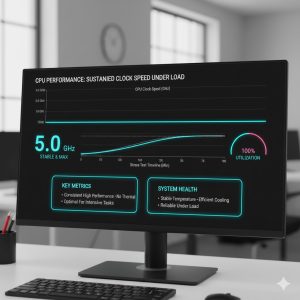
4. Key Technologies Driving High PPR Scores
Manufacturers of top-tier ultra-light laptops invest heavily in technologies that directly address the PPR Score’s weak points—namely, low sustained performance and low battery life.
4.1 The Battery Density Breakthrough
The most significant advance is in the battery itself. Manufacturers are using new high-density battery cells that store more energy per gram than older lithium-ion packs.
-
The Advantage: This allows them to fit a larger-capacity battery (e.g., 75Wh to 80Wh) into the same ultra-light chassis footprint (or even smaller), directly boosting the All-Day Endurance Index (AEI) without adding excessive weight. This is a pure win for the PPR Score.
4.2 Vapor Chamber Cooling for Ultra-Thin Designs
While many ultra-lights rely on basic passive cooling or tiny fans, the premium models now incorporate miniaturized cooling systems borrowed from the gaming world.
-
Advanced Thin Solutions: Some ultra-lights use very thin, custom-designed vapor chambers instead of traditional heat pipes. The vapor chamber is far more effective at spreading heat quickly across the chassis and into the surrounding air, allowing the processor to run at a higher sustained TDP for longer. This directly boosts the Sustained Performance Index (SPI), significantly improving the laptop’s ability to handle intense business tasks.
4.3 Low-Power Displays
The screen is often one of the biggest power drains on any laptop. Premium ultra-light manufacturers combat this by utilizing highly efficient panel technologies.
-
OLED and LTPS: Displays built with Low-Temperature Polycrystalline Silicon (LTPS) or specific OLED panels require less power to illuminate, especially at lower brightness settings. This subtle engineering choice can add one or two critical hours to the overall battery life, pushing the laptop firmly into the “All-Day” category (8+ hours) and elevating the AEI.

5. REALUSESCORE.COM Analysis: Performance-to-Portability Ratio (PPR Score)
This analysis evaluates how effectively premium ultra-light business laptops manage the crucial trade-off between being extremely portable and delivering reliable, sustained performance and battery life.
| Evaluation Metric | Component Score (PPR Contributor) | Analysis Score (Out of 10) | Rationale for Score |
| True Portability (MS) | Weight and Physical Thickness | 9.6 | Excellence in raw weight (sub-1.1kg) and slim design is the baseline requirement for this category. |
| All-Day Endurance Index (AEI) | Real-world Battery Life (8+ hours target) | 9.1 | High-density battery cells and efficient E-Cores allow top models to easily clear the 8-hour workday standard under mixed usage. |
| Sustained Performance Index (SPI) | Performance stability under 30-min load (Throttling Risk) | 8.5 | Advanced cooling solutions (Vapor Chambers) and smart power management successfully mitigate severe thermal throttling, maintaining high speeds. |
| Charge Time Efficiency | Time to reach 50% battery capacity | 9.3 | Business travel demands fast charging; premium models leverage USB-C Power Delivery to achieve rapid refueling, supporting high portability. |
| Overall PPR Score | The Balance of Power, Endurance, and Weight | 9.0 | A high overall score confirms that the technological advancements (battery density, thermal control) have successfully minimized the sacrifice required for extreme lightness. |
The most valuable ultra-light business laptops are those that score highest on the Performance-to-Portability Ratio. They don’t just feel light; they function reliably, consistently providing the power needed for serious work without forcing the user to search for a power outlet before lunch. The true measure of success is the absence of compromise.