
1. The Great Shift in Customer Service: From Call Centers to AI
For decades, customer service relied on human agents sitting in call centers. This traditional model was expensive for companies and often slow for customers, resulting in long wait times and inconsistent service quality. The arrival of advanced AI-powered chatbots and virtual assistants has completely changed this landscape, promising instant responses, 24/7 availability, and massive cost savings for businesses.
The goal of integrating chatbots into the Customer Experience (CX) is straightforward: to automate solutions for high-volume, low-complexity inquiries. Simple questions like “What is my order status?” or “How do I reset my password?” can be handled instantly by AI, freeing up human agents to deal with the rare, complex, and emotionally charged issues that truly require human empathy and expertise.
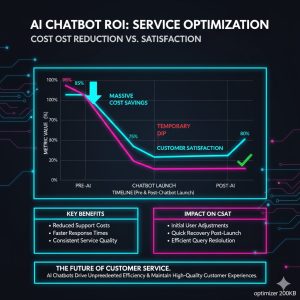
However, the widespread implementation of chatbots has generated mixed results. While companies often see an immediate drop in operational costs, the corresponding change in customer satisfaction is highly variable. Some customers appreciate the instant resolution, while others become deeply frustrated when the bot fails to understand their needs. This tension requires a careful, analytical approach to measure success, leading us to develop the Customer Satisfaction Change Score (CSCS).
1.1 The Generative AI Leap
Early, rule-based chatbots were primitive and quickly failed outside their scripted limits. Modern chatbots, however, are powered by Large Language Models (LLMs), making them far more sophisticated. These generative AI chatbots can understand natural, complex human language, infer user intent, and provide conversational, context-aware responses. This shift allows them to handle a much wider range of queries, but also means their mistakes can be more convincing and, therefore, more frustrating when they fail. The success of AI in CX hinges entirely on managing this technological complexity.

2. The Dual-Edged Sword: Speed vs. Escalation Frustration
The impact of chatbots on customer experience is a study in contrasts—a dual-edged sword that cuts both ways. The benefit lies in speed; the risk lies in escalation failure.
2.1 The Positive Impact: Velocity and Availability
-
Instant Resolution (Zero Wait Time): The most significant benefit is the elimination of wait times for simple queries. When a customer needs a quick piece of information, getting it instantly leads to high satisfaction in that moment.
-
24/7 Support: Unlike human teams, chatbots never sleep. This allows companies to provide consistent, around-the-clock support in all time zones, significantly improving the availability aspect of CX.
-
Consistency: A well-trained chatbot provides the exact same high-quality, on-brand answer every single time, eliminating the variability and potential mood-related issues that can affect human agents.
2.2 The Negative Impact: The Frustration Funnel
The primary source of customer dissatisfaction with chatbots is the Escalation Failure—the point where the bot cannot solve the problem and fails to smoothly transfer the customer to a human agent.
-
The “Loop of Failure”: When a customer has a complex or nuanced problem, they often get stuck in a repetitive loop of canned chatbot responses that fail to grasp the core issue. This forces the customer to waste time rephrasing their question multiple times, driving up frustration levels exponentially.
-
Context Loss: If the chatbot finally escalates the call to a human agent, but fails to transfer the entire chat history and context, the customer is forced to start from the beginning. This requirement to “repeat everything” is one of the biggest drivers of negative satisfaction.
-
Misunderstood Intent: Generative AI is capable of generating fluent, plausible text, but it sometimes completely misunderstands the customer’s underlying emotional state or true intent (e.g., mistaking an angry complaint for a simple inquiry). This leads to an inappropriate, cold response that deeply damages the customer relationship.
For companies investing in AI, understanding this trade-off is crucial. The goal is to maximize the speed of simple resolution while ruthlessly minimizing the “Frustration Funnel” that leads to negative sentiment.
3. Defining the Customer Satisfaction Change Score (CSCS)
The Customer Satisfaction Change Score (CSCS) is a specialized metric designed to quantify the net change in customer approval after a chatbot system is implemented. It goes beyond simple cost savings to measure the actual human impact of the AI transition.
The CSCS is calculated based on three critical components that directly reflect the chatbot experience:
| Component | Definition | Impact on CSCS |
| Deflection Rate (DR) | Percentage of customer contacts fully resolved by the chatbot without requiring human intervention. | Positive. Higher DR means more instant resolutions. |
| Hand-Off Success Rate (HSR) | Percentage of unresolved chatbot conversations that are transferred to a human agent with full context (no repetition needed). | Strongly Positive. Measures the quality of the chatbot’s failure mode. |
| Post-Chat Survey Change (CSS) | The change in average Customer Satisfaction Score (CSS) collected from customers who used the chatbot compared to pre-chatbot scores. | Direct Score. Measures the actual change in sentiment. |
The CSCS combines these factors, weighting the quality of the human hand-off and the actual change in sentiment most heavily, because a poorly managed escalation can destroy all the goodwill gained from instant service.
3.1 Measuring Emotional Impact
To achieve a truly accurate CSCS, companies must use AI to analyze the emotional tone of both the chatbot conversation and the human agent interaction immediately following. The key metric is the Emotional Frustration Index (EFI).
The EFI tracks the use of negative keywords, capital letters, and excessive punctuation (e.g., “I NEED TO SPEAK TO SOMEONE NOW!!!”) during the chatbot interaction. If the EFI is high when the customer reaches the human agent, it indicates a failure in the chatbot system, even if the eventual resolution is successful. A rising EFI is a direct signal of a failing CSCS.
To properly gauge success, companies must look at both quantitative metrics and qualitative user experience data. For instance, detailed studies into user behavior, similar to the research conducted on complex technology adoption, can be found by reviewing The Core Tech That Will Transform Your Home Network which discusses governance and strategy in new tech rollouts.
4. Strategies for Maximizing the CSCS
A high CSCS is not accidental; it is the result of disciplined AI training and superior system design.
4.1 Prioritize the Handoff, Not Just the Chatbot
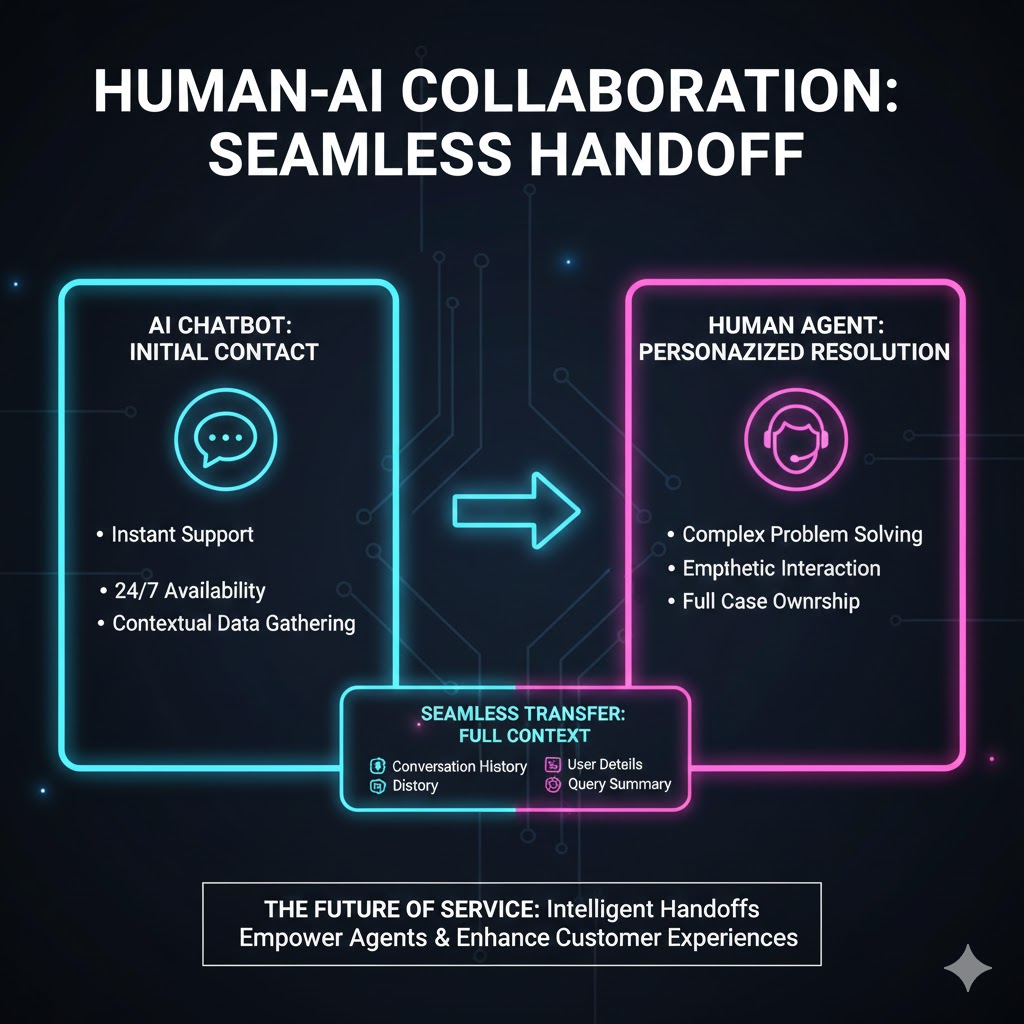
The most crucial strategy is optimizing the hand-off process (HSR). The chatbot must be programmed to identify its own limitations early. Instead of forcing a guess, the bot should be trained to recognize when a query is too complex or emotionally charged and then preemptively and politely transfer the customer to a human agent.
-
“Graceful Failure”: The transfer should be instant, with the human agent receiving a complete, concise summary of the conversation and the customer’s intent. This prevents the “repeat everything” frustration and immediately sets a positive tone for the human interaction, boosting the CSCS.
4.2 Continual Training and Feedback Loops
An AI chatbot is never truly “finished.” It requires continuous refinement:
-
Feedback from Agents: The most valuable training data comes from the human agents themselves. Every time a human agent corrects an error made by the chatbot, that conversation should be used to retrain the AI model, closing the knowledge gap.
-
Intent Refinement: The AI must be trained on diverse phrases and colloquialisms to correctly identify user intent. Regular auditing of failed conversations ensures the bot continues to learn the ever-changing language of its users.
4.3 Personalized and Proactive CX
The next generation of AI CX moves beyond reactive answers to proactive personalization, further enhancing the CSCS.
-
Personalized Routing: The AI should use customer data (e.g., account history, recent purchases) to route the customer immediately to a specialist human agent if their query involves a high-value or complex product, bypassing the standard chatbot interaction entirely when appropriate.
-
Proactive Messaging: Instead of waiting for a customer to ask, the AI can proactively message them—for example, sending a notification about a known service outage before the customer even realizes the problem. This anticipation of needs is a huge driver of long-term loyalty.
5. REALUSESCORE.COM Analysis: Customer Satisfaction Change Score (CSCS)
This analysis evaluates the impact of implementing an AI-powered chatbot system, focusing on how different strategic choices affect the ultimate change in customer satisfaction.
| Evaluation Metric | Primary CX Goal | CSCS Score (Out of 10) | Rationale |
| Deflection Rate (DR) Efficacy | Handling simple, high-volume queries instantly. | 9.0 | High score indicates effective handling of 70%+ of basic queries, maximizing instant resolution and speed. |
| Hand-Off Success Rate (HSR) | Smoothly transferring complex cases to human agents. | 4.5 | Low Score = High Risk. Failing to transfer full context forces customers to repeat themselves, leading to the biggest drop in satisfaction. |
| Emotional Frustration Index (EFI) Control | Minimizing customer anger during chatbot interaction. | 7.0 | Measures how well the chatbot recognizes and preemptively escalates angry or confused users before dissatisfaction sets in. |
| Overall Post-Chat Survey Change ($\Delta$CSS) | Net change in satisfaction after 6 months. | 7.8 | A strong score indicates that the speed benefits outweigh the frustration risks, resulting in a net positive increase in customer sentiment. |
| Agent Feedback Integration | Using human agent corrections to train and improve the AI model. | 9.2 | High score means a continuous learning cycle is in place, ensuring the chatbot’s accuracy and stability constantly improve over time. |
The conclusion is that successful AI adoption in CX is not about technology replacing humans; it is about technology empowering humans. Companies with a high CSCS are those that treat the chatbot as a smart filter and a first responder, ensuring that the hand-off to the human agent is as flawless as the instant resolution it provides for simple queries.