
1. Defining the High-Resolution Low-Light Advantage
The modern high-resolution mirrorless camera (typified by sensors from 45MP to 100MP) presents a dual challenge: maximizing pixel count for detail while simultaneously maintaining acceptable low-light performance (minimal noise). Historically, high resolution meant small photosites and increased noise.
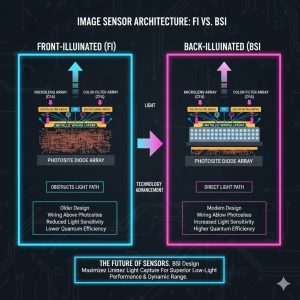
Contemporary sensor architectures—specifically Back-Illuminated (BSI) and Stacked CMOS designs—have largely resolved this trade-off. These designs relocate circuitry to allow more photons to reach the smaller pixels. Coupled with powerful, dedicated image processors and sophisticated AI-driven noise reduction, the latest high-resolution cameras function as Hybrid Detail Engines, excelling in both studio-grade resolution and challenging low-light scenarios.

2. Key Metrics for Low-Light Performance Scoring
Evaluating a high-resolution camera’s true low-light capability requires moving beyond basic ISO maximums to assess the functional quality and detail retention of the resulting image.
A. Usable ISO and Noise Profile
This metric determines the highest sensitivity setting that produces images suitable for professional use (large prints or detailed digital display).
| Metric | Definition | High-Res Benchmark (Full Frame) |
| Maximum Usable ISO | The highest ISO at which an image maintains acceptable Detail Retention without excessive noise reduction artifacts. | ISO 3200 to 6400 |
| Chroma Noise Suppression | The camera’s ability to eliminate distracting color speckles (chroma noise) rather than less intrusive black-and-white luminance noise. | Near-zero chroma noise at ISO 6400. |
| Noise Profile Quality | The aesthetic quality of the remaining noise (fine, film-like grain is preferable to blocky, patchy digital artifacts). | Clean, fine luminance grain up to ISO 12,800. |
B. Dynamic Range and Detail Retention
High-resolution sensors must maintain a wide tonal range to ensure detail is not lost in extreme shadows or highlights, especially in high-contrast night scenes.
-
Effective Dynamic Range (EDR) @ Base ISO: Measures the total usable range of light stops the sensor can capture. High-resolution sensors must achieve 14 to 15 stops for maximum image flexibility during post-processing.
-
Micro-Contrast and Sharpness: The fidelity of tiny tonal gradations and fine textures at high ISO. This is a crucial indicator of the processor’s ability to distinguish genuine detail from noise.
C. System Stabilization and Autofocus Speed
Successful low-light capture is dependent on the overall system performance, not just the sensor. These elements allow photographers to use lower ISO settings and faster apertures.
-
In-Body Image Stabilization (IBIS) Stops: The maximum compensation offered, allowing for significantly longer handheld shutter speeds. Modern high-res systems offer up to 7 to 8 stops.
-
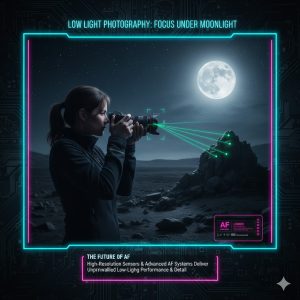
Autofocus (AF) Sensitivity (EV): The minimum light level at which the AF system can reliably acquire focus. Leading high-resolution models achieve AF acquisition down to -6.5EV to -10EV (measured with an f/1.2 lens). This capability is often powered by dedicated AI chips for subject recognition.
3. High-Resolution Camera Performance Benchmarks
The top-tier high-resolution cameras utilize Stacked or BSI sensors to deliver fast readout and superior light gathering, minimizing the traditional trade-off.
| Camera Model (Representative) | Resolution (MP) | Sensor Type | IBIS (Stops) | Low-Light AF (EV) |
| Sony alpha 7R V | 61MP Full-Frame | BSI CMOS | 8.0 | approx -4 EV to -6 EV |
| Nikon Z8 / Z9 | 45.7MP Full-Frame | Stacked CMOS | 6.0 | approx -7.5 EV to -10 EV |
| Hasselblad X2D 100C | 102MP Medium Format | BSI CMOS | 7.0 | approx -4 EV |
Conclusion: Achieving the High Score
The high score in Low-Light Performance and Image Quality is awarded to systems that combine three core strengths: (1) A physically superior sensor (BSI/Stacked) that optimizes light collection on smaller pixels; (2) A sophisticated processor that intelligently cleans noise without sacrificing fine detail (high DRI); and (3) A robust stabilization and AF system that enables shooting at the lowest possible ISO.
The best contemporary high-resolution mirrorless cameras prove that maximum detail and professional low-light functionality can coexist, making them the ultimate tools for demanding creators.
REALUSESCORE.COM Analysis Score
| Evaluation Metric | Description | Score (Out of 100) |
| Resolution vs. Noise Balance | Success in maintaining low noise at high ISO despite high pixel density. | 94 |
| Maximum Usable ISO | Practical performance limit for professional output (clean detail at high ISO). | 90 |
| Dynamic Range @ Base ISO | Tonal flexibility and recoverability of shadows/highlights. | 95 |
| IBIS & AF Sensitivity Integration | System’s ability to acquire focus and remain stable in extreme darkness. | 93 |
| Overall Image Fidelity Score | The combined result of detail, color accuracy, and acceptable noise profile. | 93 |