

The world of wireless networking is on the brink of another revolution with the arrival of Wi-Fi 7, also known as 802.11be. Following the significant upgrade brought by Wi-Fi 6E, Wi-Fi 7 promises to fundamentally change how we use the internet, especially in dense device environments. Understanding Wi-Fi 7 is crucial for anyone involved in networking technology or demanding high-speed connectivity at home.
This deep dive will explore the core technologies of Wi-Fi 7, its real-world speed implications, and the transformative impact it will have on your home network.
1. The Speed Revolution: Four Key Upgrades
Wi-Fi 7 achieves its massive speed and efficiency gains through four foundational technological upgrades. These features work in tandem to deliver theoretical peak speeds of up to 46 Gbps—a more than fourfold increase over Wi-Fi 6.
1. 320 MHz Channels: Double the Bandwidth
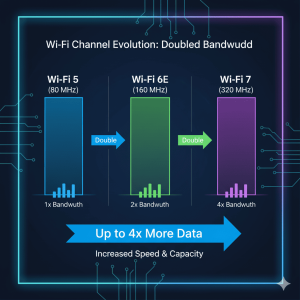
Wi-Fi 6E introduced the 6 GHz band, allowing for 160 MHz channels. Wi-Fi 7 effectively doubles this capacity, introducing ultra-wide 320 MHz channels.
Real-World Impact: Doubling the channel size means doubling the data flow. This allows devices to transmit and receive data at unprecedented speeds, making 4K and 8K streaming, VR gaming, and simultaneous large file transfers lag-free experiences. This is one of the biggest reasons for Understanding Wi-Fi 7 and its potential.
2. 4K QAM: Quadrupling Data Density
QAM (Quadrature Amplitude Modulation) is the technique used to pack data into a radio wave. Wi-Fi 6 used 1024-QAM (1K-QAM). Wi-Fi 7 significantly steps up to 4096-QAM (4K-QAM).
Real-World Impact: 4K-QAM can pack roughly 20 percent more data (12 bits per symbol) into each transmission compared to 1K-QAM (10 bits per symbol). This leads to substantial overall throughput improvements and is essential for environments with multiple high-demand devices.
3. MLO (Multi-Link Operation): Eliminating Congestion
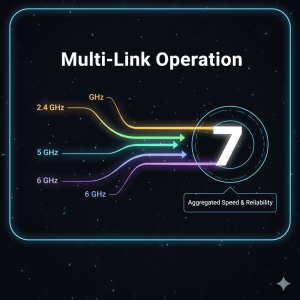
MLO is arguably the most revolutionary feature of Wi-Fi 7. It allows a device to connect to a router using multiple frequency bands simultaneously (2.4 GHz, 5 GHz, and 6 GHz).
Real-World Impact: Imagine traffic on a single-lane road—MLO opens up two or three parallel lanes. If one band (e.g., 5 GHz) becomes congested due to interference, the data can instantly switch to the clearer 6 GHz band without interruption. This dynamic link switching dramatically reduces latency (by up to 80%) and ensures consistent speed, which is vital for competitive gaming and high-fidelity video conferencing.
4. Preamble Puncturing: Maximizing Channel Utilization
In previous Wi-Fi standards, if a small part of a wide channel was occupied by interference, the entire channel became unusable. Wi-Fi 7 introduces Preamble Puncturing, which allows the network to effectively “punch a hole” around the interference and use the remaining channel segments.
Real-World Impact: This dramatically improves channel utilization in dense environments like apartment complexes. It ensures that your high-speed wide channels remain functional even when minor interference occurs from neighboring networks or devices, preserving valuable bandwidth.
2. Wi-Fi 7’s Real-World Impact on Home Networks
The combined effect of these technologies is transformative, not just in raw speed but in reliability and efficiency.
- For Gamers: MLO means near-zero latency and high throughput. It provides a stable, aggregated link that eliminates the frustrating lag spikes common in online and cloud-based gaming.
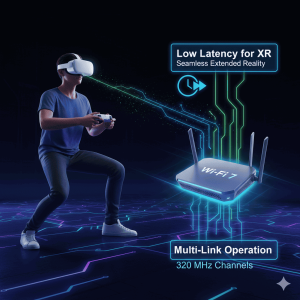
- For VR and AR Users: High throughput and consistent low latency are essential for truly immersive Extended Reality (XR) experiences. Wi-Fi 7 provides the necessary speed to stream high-resolution content to standalone headsets wirelessly.
- For Smart Homes: Wi-Fi 7’s increased capacity and efficient handling of simultaneous connections (via features like Multi-Resource Unit, MRU) ensure reliable performance for hundreds of connected smart devices, without slowing down primary devices.
- Future Proofing: By supporting 320 MHz channels and 4K-QAM, Wi-Fi 7 future-proofs the home network for the next generation of bandwidth-hungry applications like 8K video streaming and massive cloud data transfers.
3. The Real Use Score Timeline for Adoption (2025 Outlook)
Understanding Wi-Fi 7 requires acknowledging that adoption is well underway but will take time to become ubiquitous.
| Component | Status (2025) | Expected Full Adoption |
| Routers (AP) | Widely Available (High-end to Mid-range) | 2026-2027 |
| Client Devices (Smartphones, Laptops) | Premium/Flagship models only (e.g., Intel Core Ultra platforms) | 2027-2028 |
| Enterprise APs | Rapidly Deploying (Expected over a third of indoor AP revenue in 2025) | 2028 |
| Full Home Benefit | Requires both Wi-Fi 7 router AND Wi-Fi 7 devices | 2028+ |
The initial impact is seen in dedicated devices like high-end gaming laptops and premium smartphones (Intel’s vPro AI PC platform, for example, features integrated Wi-Fi 7). Dell’Oro Group predicts that Wi-Fi 7 shipments will represent over a third of Indoor AP revenues in 2025, signaling an accelerated market shift compared to previous standards.
Wi-Fi 7 is not just an incremental speed boost; it is a foundational change in how wireless data is managed. It promises a future of truly lag-free, reliable, and high-capacity wireless connectivity for every device in your home.
🟪 Ultimate home network upgrade guide
💡 Next Steps for Your Network
Are you ready to upgrade your router, or will you wait for your devices to catch up? Share your thoughts on Wi-Fi 7 in the comments below. Don’t forget to check out our other detailed tech reviews and networking deep dives to fully optimize your digital workspace.
2 thoughts on “Wi-Fi 7 (802.11be): The Core Tech That Will Revolutionize Your Home Network”