
1. The Clash of Standards: NACS vs. CCS
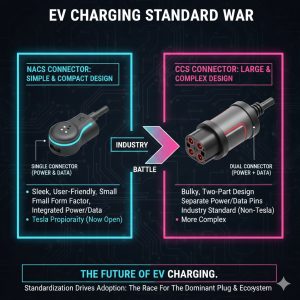
The global transition to Electric Vehicles (EVs) hinges on a robust and universal charging infrastructure. However, the industry is currently embroiled in a standards battle, primarily in North America, between two competing technologies: Tesla’s North American Charging Standard (NACS) and the Combined Charging System (CCS), which has historically been the dominant standard for non-Tesla automakers (Volkswagen, GM, Ford, Hyundai, etc.) and public charging networks.
The outcome of this “Charging War” will dictate the convenience for consumers, the investment strategies of charging network operators, and the global dominance of EV technology.
| Feature | NACS (North American Charging Standard) | CCS (Combined Charging System) | Key Advantage |
| Developer/Owner | Tesla (Open-Sourced in 2022) | SAE J1772 standard, backed by a consortium of major global automakers | Simplicity and compactness |
| Connector Design | Smaller, simpler, integrated DC and AC charging | Larger, modular design (separate AC J1772 top and DC CCS bottom) | Regulatory and global adoption |
| Maximum Power | Up to 250kW (Tesla Supercharger V3); higher on V4 | Up to 350kW in commercial deployment (potential for higher) | Higher maximum theoretical power |
| Adoption Status | Dominant in North America by volume (Tesla vehicles and Superchargers) | Global standard (Europe, Korea, most non-Tesla models) | Ease of use |
2. The NACS Momentum: Tesla’s Strategic Shift
Tesla’s decision to open-source the NACS design in 2022 fundamentally shifted the landscape. This was not a purely altruistic move but a strategic maneuver to accelerate the adoption of their connector and, critically, their Supercharger network, positioning it as the de facto industry standard in North America.
A. The Domino Effect
Following the open-sourcing, a “domino effect” of adoption occurred:
-
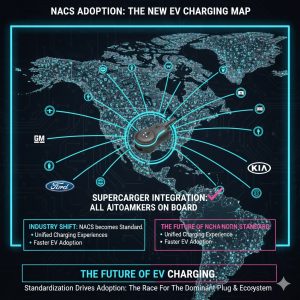
Major Automakers Switch: Within a short period, nearly every major North American automaker, including Ford, General Motors (GM), Rivian, and later Stellantis and others, announced plans to transition their future EVs to the NACS port, starting around 2025.
-
Network Integration: Key public charging networks (e.g., Electrify America, ChargePoint, EVgo) announced they would install NACS connectors on their stations alongside CCS, effectively integrating Tesla’s network into the public infrastructure.
The core drivers for this mass switch were the superior reliability, smaller connector size, and the unparalleled network coverage and user experience of Tesla’s Supercharger network.
B. The CCS Response
The CCS consortium and its proponents scrambled to respond. They emphasize CCS’s higher theoretical power delivery (up to 350kW) and its entrenched position as the global standard, especially in Europe (where the standard is mandated) and Asia. The goal is to improve the reliability of CCS charging stations and reduce the size and weight of the connector to compete with NACS’s simplicity.
3. Global Impact and Fragmentation Risks
While NACS is rapidly consolidating the North American market, the global charging landscape remains fragmented, presenting challenges for both manufacturers and consumers.
A. Europe and Asia: CCS Dominance
In Europe, the CCS standard (specifically the Type 2 variant) is mandated by the European Union, making NACS adoption highly unlikely for the foreseeable future. Similarly, in markets like Korea and China (which uses the GB/T standard), CCS and local standards remain the norm.
-
Manufacturing Complexity: Global automakers must now manufacture two versions of their vehicles: an NACS-equipped version for North America and a CCS-equipped version for the rest of the world. This adds cost and complexity to the supply chain.
B. The Consumer Experience Challenge
The immediate future requires a transitional solution:
-
Adapters: Consumers driving a non-Tesla EV with a CCS port will need an adapter to use a Supercharger, and vice-versa. While adapters work, they introduce potential points of failure and thermal issues, complicating the “plug-and-charge” experience.
-
Network Confusion: Despite consolidation towards NACS, consumers will face a chaotic network for several years, requiring constant checks on station availability and connector type.
This complex technical decision-making process, balancing a dominant established system (CCS) with a simpler, more efficient challenger (NACS), is a recurring theme in technological shifts. For a related analysis of balancing established versus new architectures, consider our deep dive into cloud infrastructure: Serverless Architecture vs. Containerization (Kubernetes): A TCO Analysis for AI Workloads.
4. The Long-Term Outlook: A Hybrid Future
The ultimate victor of the charging standard war is unlikely to be a single, global connector. The future will be defined by a hybrid infrastructure tailored to regional political and technical requirements.
A. North American Standardization on NACS
The U.S. and Canadian markets are moving decisively toward NACS as the preferred standard for new cars and public infrastructure buildout, driven by the need for simplified access to the reliable Supercharger network. Federal funding for charging infrastructure is now being directed toward NACS-compatible stations.
B. The Role of Inductive Charging
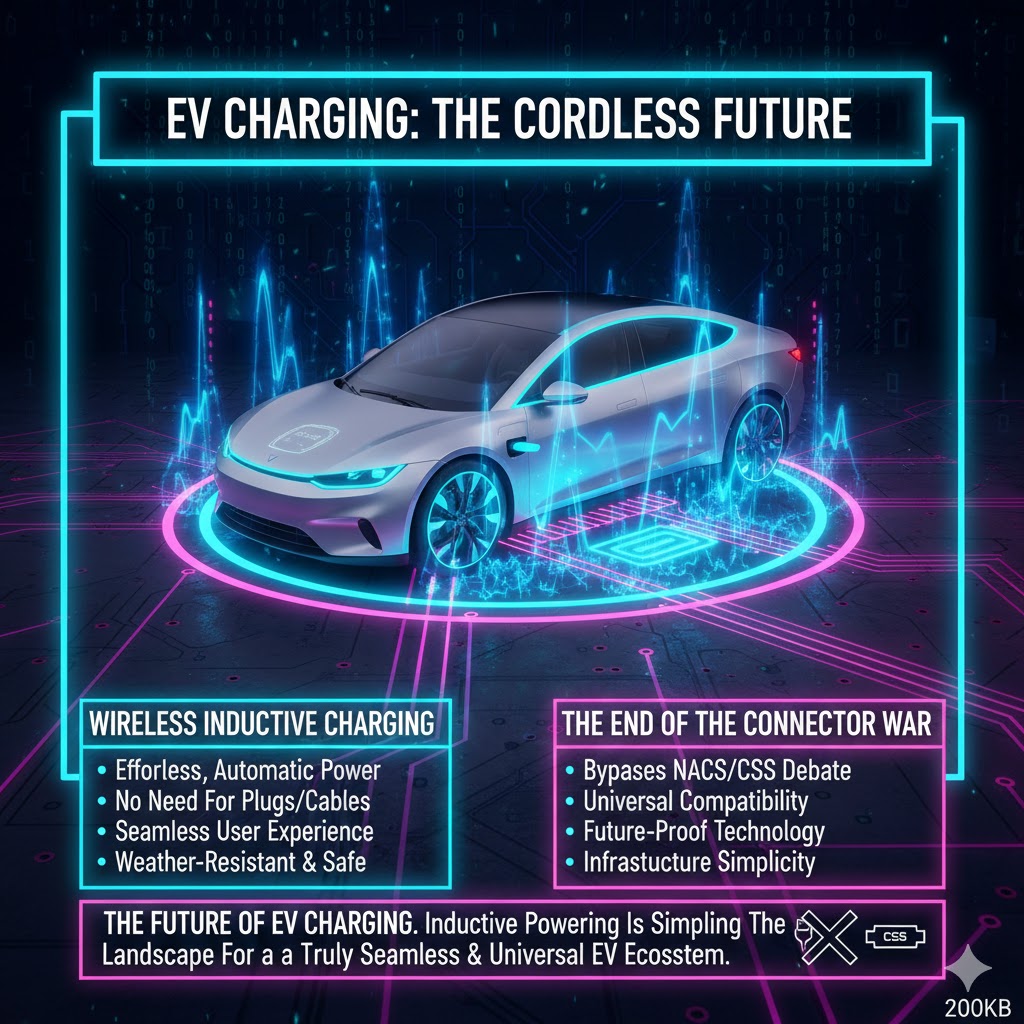
Beyond the connector war, the long-term future may involve wireless inductive charging—charging an EV simply by parking over a pad. While this technology is still nascent and offers lower power delivery, it eliminates the need for any physical connector, potentially rendering the NACS vs. CCS debate obsolete for future EV generations.
5. Conclusion: The Infrastructure Unification
The shift to NACS in North America represents a critical moment of infrastructure unification, promising a vastly improved user experience. While it creates regional fragmentation with Europe’s CCS standard, the move prioritizes consumer convenience and network reliability. The immediate challenge for the industry is managing the transition phase smoothly, ensuring that millions of existing CCS-equipped vehicles can reliably and seamlessly access the new NACS-dominant charging landscape.
REALUSESCORE Analysis Scores
Analysis of the competitive landscape and impact of the EV Charging Standard War:
| Evaluation Metric | Technical Superiority (Design) | Network Reliability (Current) | Global Adoption Potential (Long-Term) | Consumer Experience during Transition |
| NACS | 9.5 | 9.8 | 6.0 | 7.0 (via adapter) |
| CCS | 8.0 | 7.5 | 9.5 | 7.0 (via adapter) |
| REALUSESCORE FINAL SCORE | 9.0 | 8.7 | 7.8 | 7.0 |