
1. The Dawn of Direct Neural Communication
Brain-Computer Interfaces (BCIs) represent a revolutionary technology that establishes a direct communication pathway between the brain and an external device. Moving beyond simple measurement tools, advanced BCIs decode neural signals—thoughts, intentions, or motor commands—and translate them into actionable outputs, bypassing the body’s natural peripheral nervous system. This technology is fundamentally redefining human-computer interaction and holds immense promise for therapeutic applications, particularly for individuals with severe neurological disabilities.
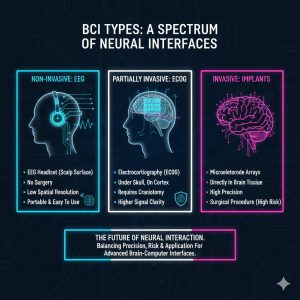
The current BCI landscape is divided into three main categories:
-
Non-Invasive BCIs: Use external sensors like EEG (Electroencephalography) caps. They are safe and easy to use but offer low spatial resolution and are susceptible to signal noise.
-
Partially Invasive BCIs: Use electrodes placed on the surface of the brain (ECoG – Electrocorticography). They offer better resolution but require cranial surgery.
-
Invasive BCIs: Involve micro-electrode arrays implanted directly into the gray matter. They offer the highest resolution and signal fidelity but carry the greatest surgical risk.
The advancement of micro-fabrication, machine learning for signal processing, and flexible electrode materials has pushed invasive and partially invasive BCIs to the forefront of therapeutic innovation.
Therapeutic Applications: Restoring Function and Agency
The primary driver for BCI research has been the potential to restore function and independence to individuals suffering from paralysis or neurodegenerative diseases.
A. Restoring Motor Function (Neuroprosthetics)
BCIs offer a pathway for paralyzed individuals to control external devices simply by thinking about moving.
-
Prosthetic Limb Control: BCIs enable individuals with limb loss or spinal cord injury to control highly advanced robotic arms or legs with near-natural fluidity, based on decoding motor intent from the motor cortex.
-
Functional Electrical Stimulation (FES): BCIs can bypass damaged neural pathways to directly stimulate muscles via FES devices, allowing people with paralysis to regain control over their own limbs (e.g., grasping an object).
-
Exoskeleton Control: BCI signals provide the high-level commands for walking or standing using robotic exoskeletons.
B. Restoring Communication (Assistive Technologies)
For patients with locked-in syndrome (LIS) or late-stage Amyotrophic Lateral Sclerosis (ALS), BCIs offer a vital bridge back to the world.
-
Direct Text Input: High-resolution BCIs can translate neural signals related to ‘imagined’ typing, cursor movement, or visual P300 brain signals into rapid, high-accuracy text input for communication.
-
Synthesized Speech: Decoding signals from the speech motor cortex can allow BCIs to generate synthesized speech directly from the user’s intended vocalization, significantly improving communication speed over traditional eye-tracking methods.
C. Neurological and Psychiatric Treatment
Beyond physical restoration, BCIs are emerging as powerful tools for treating brain disorders.
-
Deep Brain Stimulation (DBS) Optimization: BCIs, integrated with DBS devices, can monitor brain activity in real-time, allowing the stimulation parameters to be adjusted dynamically (closed-loop) to manage symptoms of Parkinson’s disease, essential tremor, or epilepsy more effectively and with fewer side effects.
-
Memory Restoration: Research is underway to use BCIs to stimulate hippocampal circuits, potentially restoring memory function damaged by conditions like traumatic brain injury or early-stage Alzheimer’s disease.

2. ⚖️ The Complex Ethical and Societal Dilemmas
As BCI technology moves from the lab to the clinic and potentially to consumer products, it raises profound ethical, legal, and social questions.
The Challenge of Cognitive Privacy
The most immediate and critical dilemma is the potential for external entities to access, decode, or manipulate a user’s private cognitive data.
-
Mental Surveillance: If BCI companies or insurers gain access to raw neural data, they could theoretically deduce intentions, memories, or emotional states. This poses a massive threat to cognitive privacy and mental autonomy.
-
Data Security and Ownership: Unlike traditional data, brain data is the ultimate expression of self. Who owns the neural data recorded by a BCI device? A security breach could expose not just identity, but the deepest parts of a user’s personality and cognition.
Autonomy, Coercion, and Enhancement
The line between therapeutic restoration and functional enhancement is blurring, raising questions about freedom and fairness.
-
Defining Therapeutic Use: Where does therapy end and enhancement begin? If a BCI restores memory function, is using it to enhance memory beyond typical human capacity ethical or fair?
-
Coercion and Mandates: Could employers or military forces mandate BCI use for monitoring performance, attention, or stress levels? This would fundamentally compromise an individual’s mental autonomy.
-
Societal Equity: High-cost, advanced BCIs could create a ‘neuro-divide,’ making superior cognitive or physical functions available only to the wealthy, exacerbating existing social inequalities.
Moral and Legal Status of BCI-Mediated Actions
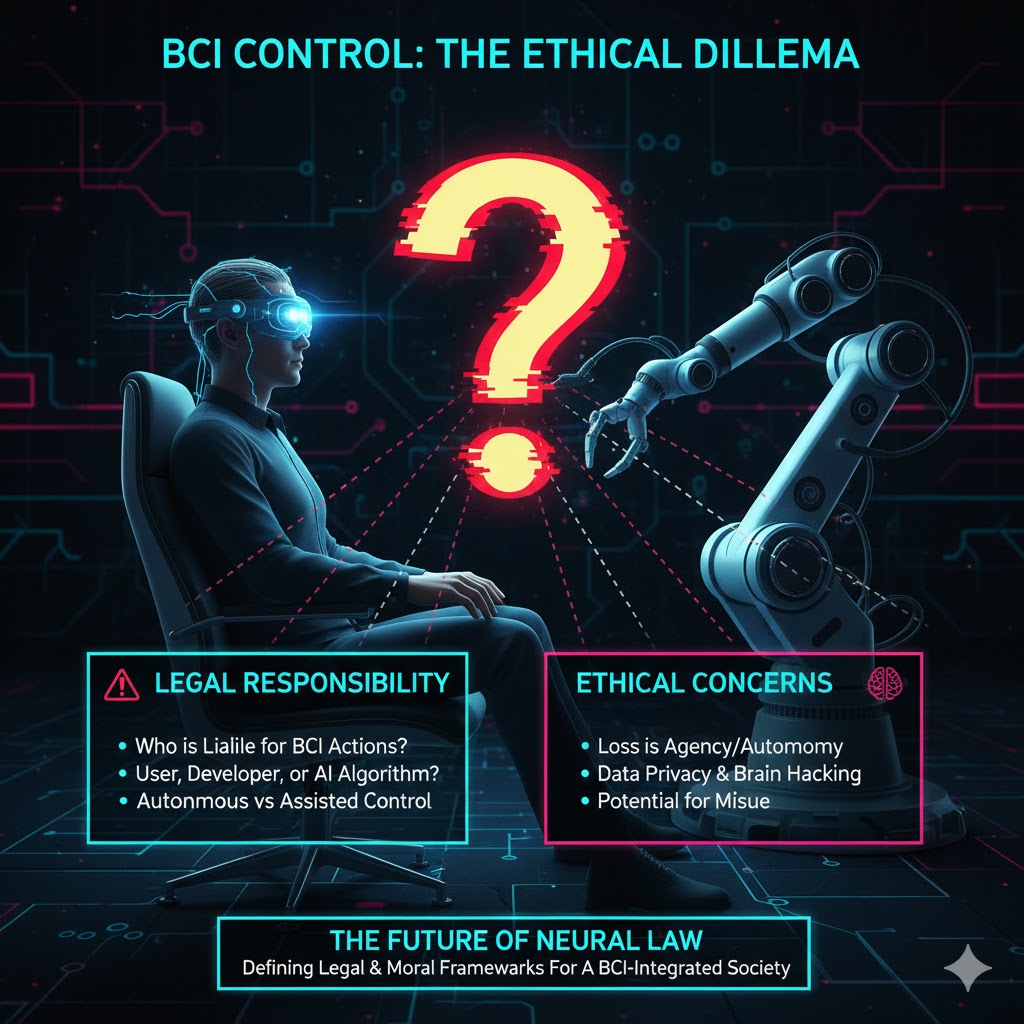
When an action is performed through a BCI-controlled device, the question of legal responsibility and moral agency becomes complex.
-
Legal Responsibility: If a paralyzed individual uses a BCI-controlled robotic arm that malfunctions and causes harm, who is legally liable: the user, the device manufacturer, or the AI algorithm that translated the intent?
-
Moral Agency: If a BCI system corrects an individual’s unintended motor command, is the resulting action purely the user’s own? Determining the level of intent originating solely from the biological brain is critical for assigning moral agency. For a deeper discussion on the intersection of human agency and technology, read our analysis: The Impact of Web3 on Content Ownership and Creator Economy: A 2026 Forecast.
3. The Need for “Neuro-Rights” and Governance
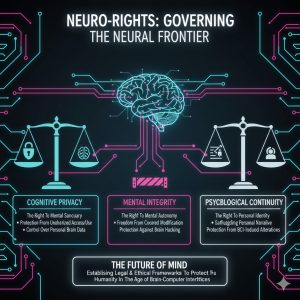
Addressing these challenges requires proactive regulatory frameworks that codify and protect fundamental cognitive rights. Chile has already amended its constitution to protect “neuro-rights,” setting a global precedent. Key areas for governance include:
-
The Right to Mental Privacy: Protection against unconsented reading or monitoring of neural data.
-
The Right to Mental Autonomy: Protection against external manipulation of one’s thoughts, judgments, or decisions.
-
The Right to Access: Ensuring equitable access to therapeutic BCIs, regardless of socioeconomic status.
The future of BCI is not merely a technical challenge but a philosophical one. Its integration into society demands robust ethical guidance to ensure this powerful technology serves humanity without compromising the essence of what it means to be human.
REALUSESCORE Analysis Scores
Analysis of BCI’s impact and the governance challenges it presents:
| Evaluation Metric | Therapeutic Potential | Signal Decoding Fidelity | Cognitive Privacy Risk | Legal/Regulatory Preparedness |
| Technology Driver | 9.7 | 9.5 | 9.8 | 6.5 |
| Current Adoption Rate | 6.0 | 7.0 | 5.5 | 5.0 |
| REALUSESCORE FINAL SCORE | 9.4 | 9.2 | 6.1 | 5.7 |