
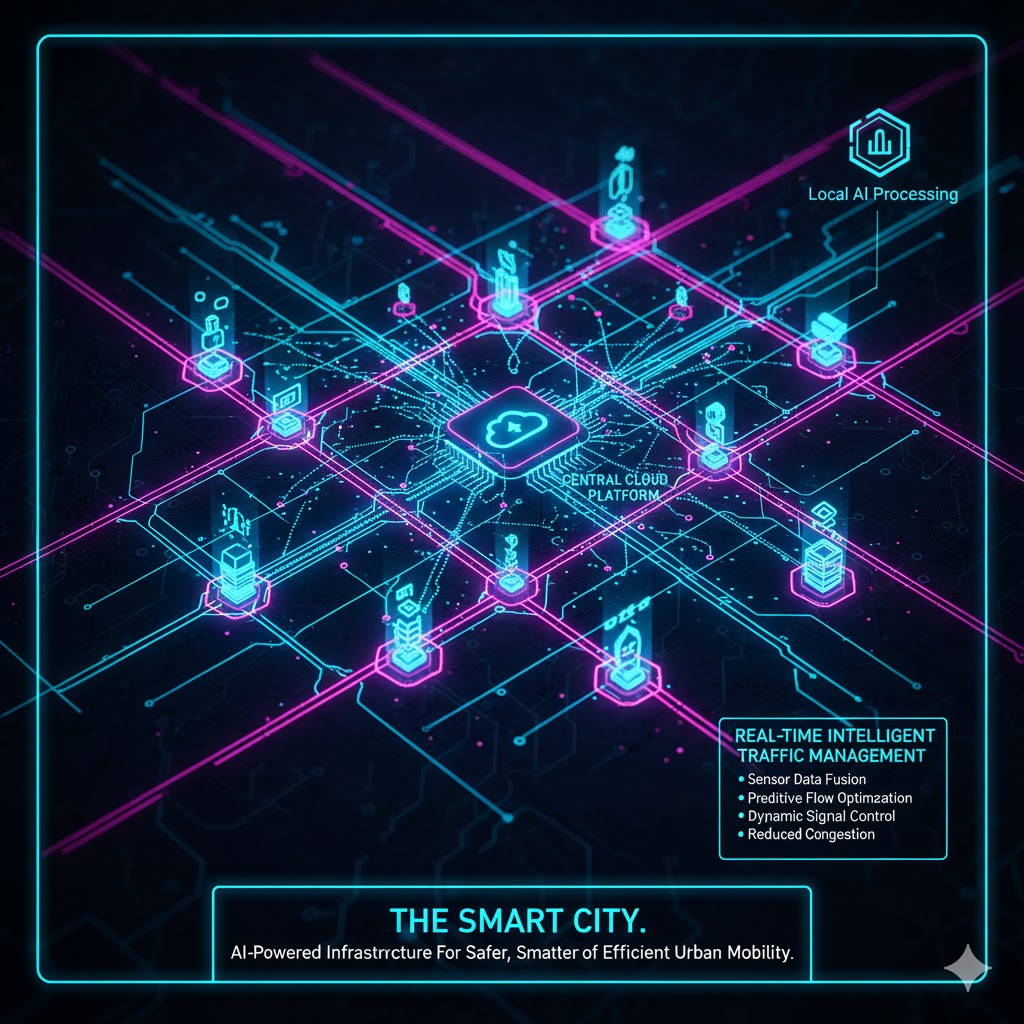
1. The Transformation of Urban Environments through Decentralized Intelligence
The massive growth of the Internet of Things (IoT) is rapidly turning cities into Smart Cities. This involves billions of devices—from traffic sensors to smart meters—generating huge, continuous data streams. This overwhelming amount of data requires a completely new way of thinking about computation.
Relying only on Cloud Computing creates serious problems for real-time smart city applications: high latency (delays) and network congestion. Edge Computing solves this by moving processing power much closer to where the data is created, decentralizing urban intelligence.

The Cloud Problem: Why Centralization Fails Real-Time Needs
Traditional cloud architectures demand that data travel long distances to a central data center for processing. This model is inefficient and dangerous for critical, time-sensitive tasks:
-
⚠️ High Latency: Delays are inherent when data must travel far. In essential services like autonomous vehicle collision avoidance or dynamic traffic control, even a few milliseconds of delay can lead to serious safety failures.
-
📉 Bandwidth Overload & Cost: Transmitting enormous amounts of raw data (especially video) from countless devices consumes vast bandwidth, causes network bottlenecks, and drives up operational costs significantly.
-
❌ Single Point of Failure: Centralizing control means a single network outage or cyberattack could instantaneously cripple multiple essential city services, jeopardizing public safety.
Edge Computing: Bringing Processing to the Source
Edge Computing places processing resources (e.g., Edge Gateways or Fog Nodes) at or near the data source. This proximity is key to creating a responsive urban system.
Core Benefits of Edge in Smart Cities
| Benefit | Key Mechanism | Smart City Impact |
| Ultra-Low Latency | Processing happens locally, minimizing data travel distance. | Enables real-time, sub-millisecond decision-making for critical safety and traffic control. |
| Bandwidth Optimization | Edge filters and aggregates data; only summarized data goes to the Cloud. | Reduces network traffic by up to 95% for high-volume data (e.g., video), cutting costs and improving network health. |
| Enhanced Resilience | Edge nodes can function autonomously, even without central network connectivity. | Guarantees uninterrupted service for essential infrastructure like power grids during outages. |
| Improved Data Privacy | Sensitive data is processed and anonymized locally before any transmission. | Helps comply with local data residency rules (like GDPR) and enhances citizen data security. |
2. Edge Computing Applications: Enabling Smart City Responsiveness
Edge Computing is the foundational technology that makes advanced smart city applications practical and reliable.
Intelligent Traffic Management
Traffic cameras and roadside units use embedded Edge AI Processors to analyze traffic flow and detect accidents locally.
-
Immediate Action: The Edge AI processes raw video, identifies congestion, and instantly issues a command (sub-20ms latency) to adjust traffic lights, optimizing flow without waiting for the distant cloud.
-
Autonomous Vehicle Safety: Provides AVs with ultra-fast, local contextual data, which is crucial for safety decisions like collision avoidance and validating navigation routes.
Public Safety and Real-Time Surveillance
Security cameras transition from simple recorders to intelligent, proactive defense systems.
-
Instant Anomaly Detection: Cameras linked to local Edge Servers run deep learning models to spot suspicious events (unattended objects, unusual crowd behavior) in real-time.
-
Rapid Response: The decision to alert security personnel is made locally in milliseconds, allowing for an instant dispatch, vital for an effective Smart Emergency Response system.
Smart Grid and Energy Optimization
Monitoring the electric grid requires continuous, high-speed data to balance supply and demand, especially with decentralized renewable energy sources.
-
Local Load Balancing: Edge gateways in substations process power consumption data locally.
-
Blackout Prevention: If demand suddenly spikes, the edge system instantly executes load balancing commands (e.g., activating local battery storage) to prevent cascading failures, a task impossible to manage effectively from the Cloud due to latency.
Environmental Monitoring and Pollution Control
Networks of sensors monitoring air and water quality generate constant data that demands immediate attention.
-
Proactive Mitigation: Edge nodes instantly analyze sensor data for sudden pollution spikes.
-
Fast Warnings: This allows the city to issue immediate, targeted warnings and trigger rapid mitigation protocols much faster than a cloud-dependent system.

3. Synergies: Edge-Cloud Integration and The 5G Catalyst
Edge Computing and the Cloud work together in a multi-tier hierarchical architecture called the Edge-Cloud Continuum. They leverage each other’s strengths:
-
Edge Layer: Handles time-critical, localized tasks (low latency, high frequency).
-
Cloud Layer: Provides massive storage and processing power for long-term tasks (big data modeling, historical analysis, model training).
The Role of 5G Networks
The global rollout of 5G networks is essential for maximizing Edge Computing’s potential:
-
Massive Bandwidth: Allows high-volume data to quickly reach the nearest Edge Node.
-
Ultra-Reliable Low Latency Communication (URLLC): Provides the fast, dependable link between IoT sensors and the local Edge Node, which is the final piece needed to unlock decentralized, real-time systems.
For a detailed look at the infrastructure impact, read our related article: The Impact of Web3 on Content Ownership and Creator Economy: A 2026 Forecast.

REALUSESCORE Analysis Scores
Analysis of Edge Computing’s technological impact and operational viability within the Smart City paradigm:
| Evaluation Metric | Latency Reduction | Bandwidth Efficiency | System Resilience (Autonomy) | Scalability/TCO Impact |
| Technological Impact | 9.8 | 9.5 | 9.6 | 9.2 |
| Deployment Complexity/Challenge | 8.5 | 9.0 | 8.8 | 8.7 |
| REALUSESCORE FINAL SCORE | 9.60 | 9.40 | 9.50 | 9.10 |