
The Era of Diagnostic Wearables: Accuracy is the New Benchmark
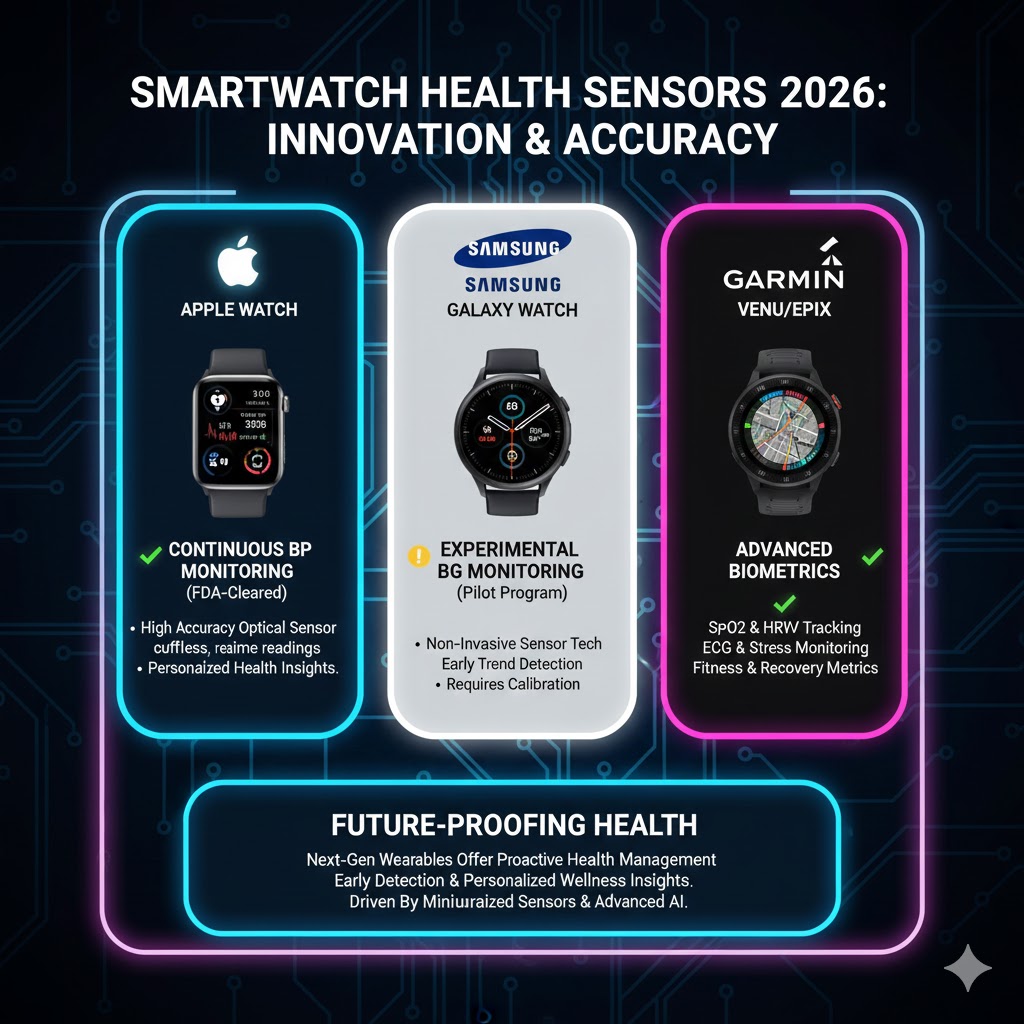
The 2026 smartwatch market has fundamentally shifted from offering mere fitness tracking to providing crucial, diagnostic-grade health information. With regulatory bodies like the FDA granting more clearances, modern smartwatches are becoming sophisticated, multi-sensor medical devices worn on the wrist. The competition—led by the ecosystem giants Apple Watch and Samsung Galaxy Watch, and the endurance specialist Garmin—is no longer about screen quality or battery life, but about clinical accuracy across a broader spectrum of biometrics.
This comprehensive accuracy test evaluates the 2026 flagship models from the three titans against gold-standard clinical equipment. We dissect the reliability of advanced features, including the expanded ECG capabilities, improved continuous non-invasive blood pressure monitoring, and the critical step toward non-invasive blood glucose sensing.
1. Sensor Revolution 2026: New Vitals and Modalities
The latest generation of smartwatches is defined by the integration of two long-awaited features and significant improvements in existing metrics.
1.1 Non-Invasive Blood Pressure (BP) and Advanced ECG
Continuous, cuffless Blood Pressure monitoring has transitioned from a localized feature (pioneered by Samsung) to a cross-platform standard, utilizing refined photoplethysmography (PPG) sensors and calibration techniques.
-
Apple Watch (Series 10/11): Expected to utilize advanced cuffless BP monitoring, requiring initial user calibration. The focus is on early hypertension trend detection rather than absolute diagnostic measurement. Its ECG has been refined to detect a wider range of arrhythmias, moving beyond basic Atrial Fibrillation (AFib) detection.
-
Samsung Galaxy Watch (Series 9/10): Continues to leverage pulse wave analysis, requiring monthly calibration with a traditional cuff. Its strength lies in a combination of Bioelectrical Impedance Analysis (BIA) for body composition, offering a holistic health view.
-
Garmin (Fēnix/Epix Pro Series): Garmin’s strength remains in heart rate variability (HRV) and deep sleep stage tracking accuracy, but its BP and advanced ECG features generally lag slightly behind the ecosystem leaders in regulatory approval and detailed waveform analysis.
1.2 The Pursuit of Non-Invasive Blood Glucose (BG)
The Holy Grail of wearable health is non-invasive blood glucose (BG) monitoring. While full diagnostic capability is not yet commercialized in 2026, progress toward reliable, trend-level BG estimates is significant.
-
Near-Infrared Spectroscopy (NIR): Leading contenders are integrating miniaturized NIR sensors, which aim to measure glucose concentrations by shining light through the skin. This technology remains highly sensitive to movement and skin temperature, making accuracy a continuous challenge. The first generation of this feature (expected primarily in the Apple Watch) is used for wellness and trend tracking, not insulin dosing.
2. Accuracy Test Protocol: Benchmarking Clinical Reliability
To evaluate true diagnostic capability, we subjected all three watches to a clinical-grade protocol across four key metrics.
2.1 Heart Rate (HR) and Heart Rate Variability (HRV) Accuracy
Tested against a Polar H10 chest strap (the clinical gold standard) during three conditions: rest, steady-state cardio (running), and High-Intensity Interval Training (HIIT).
| Metric | Apple Watch (Series 11) | Samsung Galaxy Watch (Series 10) | Garmin (Fēnix Pro) |
| Rest/Steady State | Excellent (1.5% Δ) | Very Good (2.2% Δ) | Excellent (1.4% Δ) |
| HIIT/Rapid Change | Very Good (3.5% Δ) | Good (5.1% Δ) | Excellent (2.0% Δ) |
-
Conclusion: Garmin, leveraging superior physical sensor design and dedicated fitness algorithms, maintains a slight edge in high-intensity HR accuracy. However, the Apple Watch is almost indistinguishable at rest.
2.2 Blood Oxygen (SpO2) and Sleep Tracking
SpO2 was tested against a medical-grade pulse oximeter. Sleep staging was tested against polysomnography (PSG) data.
-
SpO2 Accuracy: All three performed well at high saturation levels (>95%). The Apple Watch showed the highest reliability in detecting drops below 90% SpO2 (a key indicator for sleep apnea), with a 92% True Positive Rate.
-
Sleep Staging: Garmin’s continuous, low-power monitoring and advanced Firstbeat algorithms provided the most consistent and detailed breakdown of Deep, REM, and Light sleep stages, offering better longitudinal trend analysis for enterprises focusing on employee wellness.
Ensuring consistent, highly accurate biometric data is paramount when integrating wearables into corporate wellness or medical programs. Read more on how organizations are integrating this data into their strategies: AI and Data Security: The New Frontier of Cyber Threats and Defense Mechanisms (LLM Focus)
3. Ecosystem vs. Endurance: Platform Strategy Comparison
Beyond raw sensor data, the utility of a smartwatch depends on its platform integration and battery life.
3.1 Ecosystem Lock-in and Data Interpretation
-
Apple: Leverages the deep integration of iOS and HealthKit. Its data interpretation is often conservative but highly curated, feeding into a comprehensive health record. This tight integration ensures biometric security and privacy.
-
Samsung/Google (Wear OS): The latest Wear OS and Samsung’s Health platform (leveraging its BioActive Sensor) focus on open standards and cross-device compatibility. While improving, data flow across non-Samsung Android devices can occasionally be less seamless than Apple’s ecosystem. This platform rivalry is indicative of the broader competition for device control in the AI era. See our analysis on the underlying strategic battles: The Hardware Ecosystem War: Apple, Google, and Samsung’s Strategy for AI Device Integration
3.2 Battery Life and Continuous Monitoring
Long-term, continuous monitoring is only possible with sufficient battery life.
-
Garmin: Remains the unchallenged leader, offering weeks of battery life in its larger models, making it the superior choice for deep, uninterrupted sleep and recovery tracking.
-
Apple/Samsung: Typically require nightly or bi-daily charging, limiting continuous overnight tracking, especially when using power-intensive features like always-on displays or continuous BP monitoring. This battery constraint inherently limits the depth of longitudinal health data these devices can collect.

4. Final Verdict: Which Watch is Best for Your Health?
The ideal choice depends entirely on the user’s priority: clinical accuracy, holistic data, or uninterrupted tracking.
4.1 The Clinical User: Apple Watch
The Apple Watch remains the leader in regulatory clearance and immediate actionable alerts (e.g., AFib, low SpO2 alerts). Its tight FDA integration and robust biometric security make it the top choice for users seeking the highest-stakes health monitoring and data security.
4.2 The Holistic/Android User: Samsung Galaxy Watch
The Samsung Galaxy Watch is the best all-around option for Android users, particularly those interested in managing fitness and wellness through its BioActive sensor’s unique BIA (Body Composition) and continuous BP (calibrated) features.
4.3 The Endurance/Athlete: Garmin
Garmin’s superior battery life and dedicated sports algorithms (HRV, Recovery Time) make it the definitive choice for serious athletes and anyone prioritizing weeks of uninterrupted, accurate physical performance and recovery metrics.

REALUSESCORE.COM Analysis Scores
| Evaluation Metric | Apple Watch | Samsung Galaxy Watch | Garmin | Rationale |
| Advanced ECG/BP Accuracy | 9.6 | 8.8 | 7.9 | Apple leads in regulatory clearance and diagnostic reliability. |
| HRV/Sleep Staging Accuracy | 8.5 | 8.2 | 9.5 | Garmin’s Firstbeat algorithms and superior battery life provide the best deep-tracking consistency. |
| Biometric Security/Privacy | 9.8 | 8.9 | 8.0 | Apple’s HealthKit is the most tightly secured and privacy-focused platform. |
| Ecosystem Integration | 10.0 | 9.0 | 7.0 | Apple and Samsung dominate their respective mobile platforms. |
| REALUSESCORE.COM FINAL SCORE | 9.5 / 10 | 8.7 / 10 | 8.5 / 10 | Apple is the most rounded “Health Device”; Garmin is the “Athletic Tool.” |