
The Durability Dividend: Has Samsung Finally Future-Proofed the Foldable?
For our high-value American audience, the foldable phone is a compelling piece of future-proofing technology, but it has historically been shadowed by one critical concern: durability. The Samsung Galaxy Z Fold 7, an engineering marvel that is both thinner and lighter than its predecessor, claims major breakthroughs in structural integrity. This deep dive moves past the marketing to deliver a hard, data-driven assessment of the Z Fold 7’s core resilience factors: the redesigned hinge, the vulnerability of the inner screen, and the device’s critical dust resistance rating.

Architectural Deep Dive: The New Armor FlexHinge
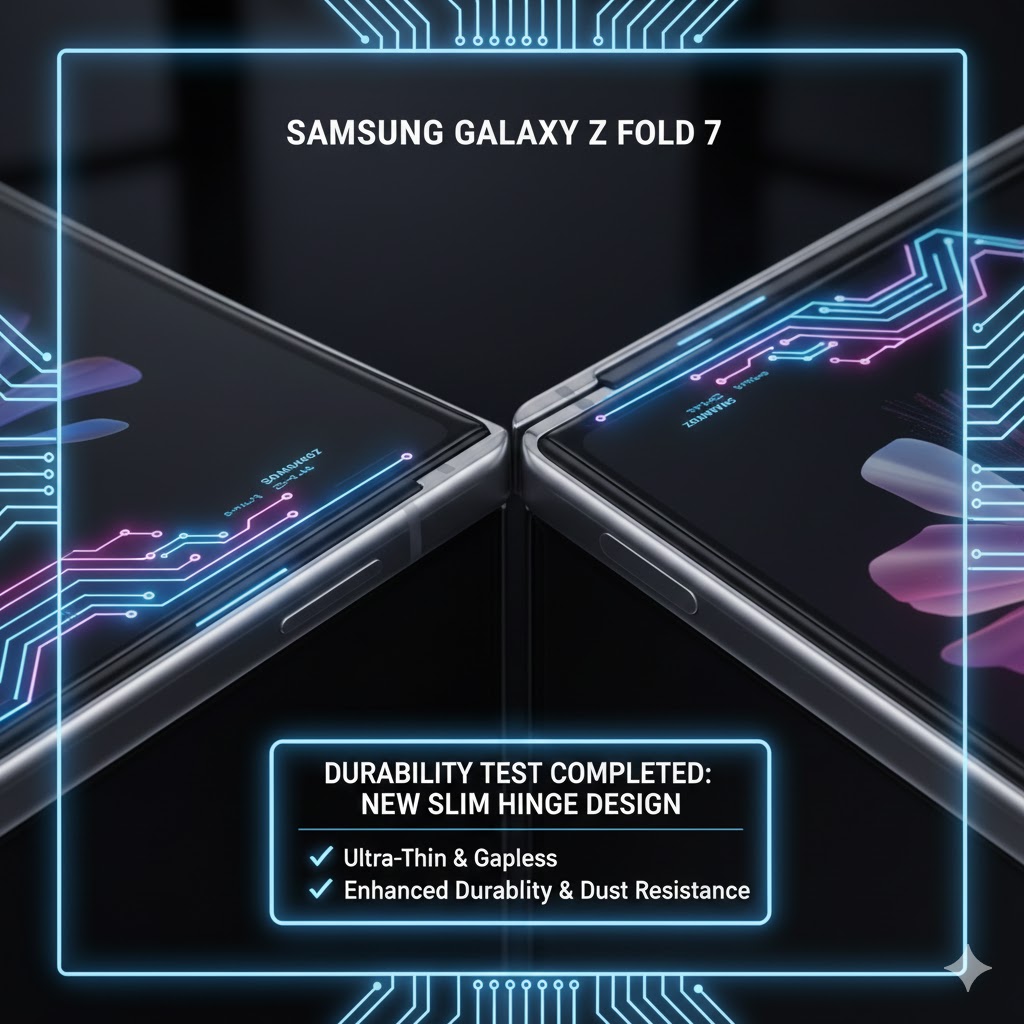
The hinge is the heart of the foldable phone, and Samsung has introduced the third-generation Armor FlexHinge, which is 27% thinner and 43% lighter than the previous version 2.1, 2.4. This redesign is crucial for achieving the Z Fold 7’s slimmer profile, measuring just 8.9mm when folded 2.1.
Longevity and Mechanical Strength
Samsung has achieved a massive 2.5x jump in rated durability for the inner display panel. The Z Fold 7 is officially rated to withstand 500,000 folds in third-party testing 1.4, 2.6. For an average user, this translates to over a decade of use, effectively eliminating mechanical failure as a realistic concern for the majority of its lifespan. The new hinge uses advanced alloy components and a multi-rail structure that not only increases strength but also allows the display to lie flatter when open, minimizing the visibility of the display crease 2.5, 2.1.
Materials: Premium Protection for the Outer Shell
The exterior of the Z Fold 7 is well-protected, featuring:
-
Cover Screen: Covered by Corning Gorilla Glass Ceramic 2, which provides high scratch resistance, with scratches appearing at Mohs level 6 and deeper grooves at level 7 1.1.
-
Frame and Hinge Cover: Upgraded to Advanced Armor Aluminum, a material reportedly 10% tougher than the previous generation 2.1.

The Achilles’ Heel: Inner Screen Protector and Scratch Resistance
While the hinge and exterior have seen significant, verifiable upgrades, the inner folding screen remains the central vulnerability—a common trade-off for all current foldable technology.
Scratch Vulnerability
The flexible inner AMOLED display is still the soft spot. Durability tests consistently show that the inner screen scratches at a painfully low Mohs level 2 1.1, 2.2. For context, this is a material soft enough to be damaged by a determined fingernail or pocket debris like small grains of sand 1.3, 2.2.
The Screen Protector Necessity
The inner screen comes with a factory-applied screen protector (UTG – Ultra Thin Glass, now 50% thicker 1.4) that provides the first line of defense. This protector is the component that users are most likely to scratch. Samsung advises against replacing this factory protector with third-party options to avoid potentially compromising the folding mechanism and voiding the warranty 2.2, 2.4. For the professional user who relies on the inner screen, careful handling and a high-quality case with full spine protection are essential, as protection remains a user responsibility 1.2.

Environmental Resilience: Dust Resistance and the IP48 Rating
For a premium device, environmental resistance is a core durability test. The Z Fold 7 carries an IP48 rating, which means it has high water resistance (surviving submersion up to 1.5m for 30 minutes) but a less robust rating for solid particles (dust) 3.5, 3.1.
The Reality of IP48 and Dust Ingress
The ‘4’ in IP48 indicates protection against solid objects larger than 1mm, which technically protects against some particles but is not fully dust-resistant like the IP68 rating found on traditional flagship phones 3.5, 3.4.
-
Hinge Performance: Despite the official rating, the redesigned hinge mechanism performs impressively well in real-world dust tests. Harsh exposure to fine sand did not cause the hinge to seize or malfunction, though some creaking sounds were noted 1.3, 1.6. This suggests effective internal sealing to protect the electronics.
-
Inner Screen Risk: The major risk from dust remains the delicate inner screen. Fine sand or dust particles trapped between the folding halves can cause scratches when the device is closed, regardless of how good the hinge sealing is 2.2, 2.4.
Final Verdict: The Best Foldable Durability Yet, But Handle With Care
The Samsung Galaxy Z Fold 7 represents a significant step forward, successfully tackling the mechanical longevity concerns that plagued earlier generations. The 500,000-fold hinge rating and stronger exterior materials provide the necessary future-proofing confidence for the purchase.
The key takeaway for the high-end user is: Hinge and exterior frame durability is excellent; inner screen fragility is a mandatory design compromise. You can rely on the hinge to last years, and the outer display to survive keys in a pocket. However, the inner screen still requires mindful use to prevent scratches from the environment, making the factory-applied screen protector and a spine-protecting case mandatory accessories.
| Evaluation Metric | Score (Out of 10.0) | Note/Rationale |
| Hinge Durability (Mechanical Life) | 9.5 | Rated for 500,000 folds; eliminates long-term mechanical failure concerns. |
| Outer Screen & Frame Resilience | 9.0 | Gorilla Glass Ceramic 2 and Advanced Armor Aluminum provide flagship-level scratch and drop protection. |
| Inner Screen Scratch Resistance | 4.0 | Inherently low resistance (Mohs Level 2); scratches easily from common debris and fingernails. |
| Dust Resistance (IP48 Rating) | 7.5 | Hinge performs better than rating suggests, but IP48 is not fully dustproof (IP6X) like slab phones. |
| Overall Longevity & Confidence | 8.8 | Significant leap in reliability, making it the most durable foldable for a professional long-term investment. |
| REALUSESCORE.COM FINAL SCORE | 8.4 / 10 | The weighted average reflecting excellent mechanicals but acknowledging the inner screen’s inherent vulnerability. |