

Beyond 5G: The Dawn of the Terahertz Era and the Intelligent Network
For our audience of technically sophisticated professionals and investors, 6G is more than just faster internet; it represents a fundamental re-engineering of the global digital infrastructure. While 5G focused on enhanced Mobile Broadband (eMBB) and Ultra-Reliable Low-Latency Communication (URLLC), 6G Communication Technologies are aiming for a performance leap that blurs the lines between the physical, digital, and human worlds.1 Expected to arrive commercially around 2030, 6G promises Terabit-per-second data rates, microsecond latency, and the profound integration of Artificial Intelligence (AI) and sensing into the network itself.2 Understanding these core technologies is essential for future-proofing any technology investment.
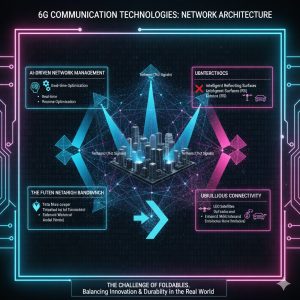
Architectural Deep Dive: Core Technologies Enabling 6G
Achieving 6G’s extreme performance metrics requires a combination of revolutionary and evolutionary technological leaps that redefine spectrum use, network architecture, and intelligence.3
1. Terahertz (THz) Communication4
This is the single most defining new technology for 6G. THz frequencies (ranging from 100 GHz to 10 THz) offer massive, previously unused blocks of spectrum.5
-
Benefit: This huge bandwidth is the key to achieving peak data rates of up to 1 Tbps 1.7, 3.2—a hundredfold increase over 5G.
-
Challenge: THz signals suffer from severe path loss and blockage 1.1, meaning they struggle to penetrate objects. This challenge necessitates the deployment of other complementary technologies.6
2. Reconfigurable Intelligent Surfaces (RIS)
RIS technology is the solution to the THz communication challenge. These surfaces are composed of thousands of passive, low-cost metallic elements that can digitally manipulate (reflect, refract, or absorb) incoming radio waves 1.5, 3.3.
-
Benefit: RIS effectively turns walls, buildings, and other obstacles into smart mirrors that can redirect signals around blockages, ensuring continuous coverage and enhancing energy efficiency 1.4.7 This is crucial for enabling the high-frequency THz signals to reach users in non-line-of-sight conditions.
3. AI-Native Networking and Integrated Sensing and Communication (ISAC)8
6G is designed to be AI-native from its foundation, meaning AI is used to optimize every layer of the network, from resource allocation to spectrum sharing 3.1.9
-
AI-Native: This intelligence enables the network to self-heal, self-optimize, and adapt to changing traffic in real-time, greatly improving energy efficiency and reducing operational costs 1.2.
-
ISAC (Sensing): A radical shift where the network not only communicates but also senses the environment.10 The radio waves bouncing off objects can be used for high-precision localization, gesture recognition, and creating real-time “Digital Twins” of the physical world 2.7, 3.4.11
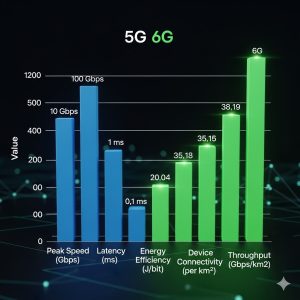
The Triumphant Trio: Key Performance Indicators (KPIs)
6G is defined by its ability to push the boundaries of three core performance metrics simultaneously, moving far beyond the capabilities of 5G.
| KPI | 5G (Current Target) | 6G (Expected Target) | Benefit for Applications |
| Peak Data Rate | 20 Gbps | 1,000 Gbps (1 Tbps) 3.2 | Enables holographic telepresence and instant 3D data transfer. |
| Latency (End-to-End) | 1 ms | Sub-100 microseconds (0.1 ms) 1.7 | Critical for remote surgery, autonomous systems, and ultra-reliable industrial control. |
| Connected Devices (Density) | $10^6$ devices/$\text{km}^2$ | $10^7$ devices/$\text{km}^2$ 1.2 | Massive support for Zero-Energy IoT and body area networks. |
Ultra-Reliability and Precision
6G aims to elevate reliability to $99.99999\%$ (seven nines) for mission-critical applications 2.2. The integration of sensing also boosts localization accuracy from the current meter level to centimeter level 2.2, which is non-negotiable for synchronized robotics and autonomous driving systems.12

Expected Benefits: The New Age of Immersive Connectivity
The combination of extreme speed, near-zero latency, and pervasive AI will unlock a wave of applications that are currently impossible with 5G. These are the expected benefits that justify the massive infrastructure investment:
1. Hyper-Immersive Experiences (Extended Reality – XR)13
6G enables truly hyper-realistic holographic telepresence and extended reality (XR) 2.2, 2.7.14 Transmitting a full, uncompressed 3D holographic display requires data rates approaching 4.32 Tbps 2.2. While initial commercial 6G may not hit this mark instantly, the network architecture is designed to support the eventual transition to multi-sensory communication, including tactile internet (sending the sense of touch) 2.7.
2. Digital Twins and Autonomous Systems
The network’s sensing capability will create real-time, digital replicas (Digital Twins) of physical environments, factories, and even entire cities 2.6.15
-
Industrial Automation: Sub-millisecond latency is essential for complex collaborative robotics and real-time motion control in Industry 4.0 2.2.16
-
Smart Cities: Real-time 4D maps, updated by the network itself, allow for autonomous management of public transport, waste, and energy systems 1.3.17
3. Ubiquitous Coverage and Sustainability
6G Communication Technologies are being designed to integrate Non-Terrestrial Networks (NTN), primarily satellites, to provide seamless, unified coverage across air, sea, and remote rural areas, addressing the digital divide 3.1.18 Furthermore, sustainable system design is a core pillar, leveraging AI to drastically improve network energy efficiency and reduce the overall environmental footprint 3.4.19
Final Verdict: The Innovation Platform for the Next Decade
6G Communication Technologies represent a paradigm shift: the network ceases to be just a data pipe and becomes an intelligent, sensory platform.20 For the modern professional, this leap means the end of lag, the birth of truly realistic holographic collaboration, and the ability to control complex systems remotely with microsecond precision. The investment in 6G is an investment in an ecosystem where AI, sensing, and communication are indivisible, fundamentally future-proofing entire industries for the next decade and beyond.21
| Evaluation Metric | Score (Out of 10.0) | Note/Rationale |
| Peak Data Rate Potential (THz) | 9.7 | Unprecedented potential for 1 Tbps speed due to the expansion into Terahertz spectrum. |
| Latency & Reliability (Critical Systems) | 9.8 | Targeting latency and reliability for autonomous control. |
| Architectural Innovation (RIS & ISAC) | 9.5 | RIS overcomes THz limitations; ISAC integrates sensing, creating a smart, unified platform. |
| Expected Benefits (Holography/Digital Twin) | 9.6 | Unlocks applications (Holographic Telepresence) that 5G cannot support due to bandwidth/latency limits. |
| Commercial Viability & Deployment (2030) | 7.5 | Deployment faces massive challenges with new hardware (THz) and infrastructure costs. |
| REALUSESCORE.COM FINAL SCORE | 9.2 / 10 | Weighted average reflecting monumental technical potential despite high near-term deployment hurdles. |